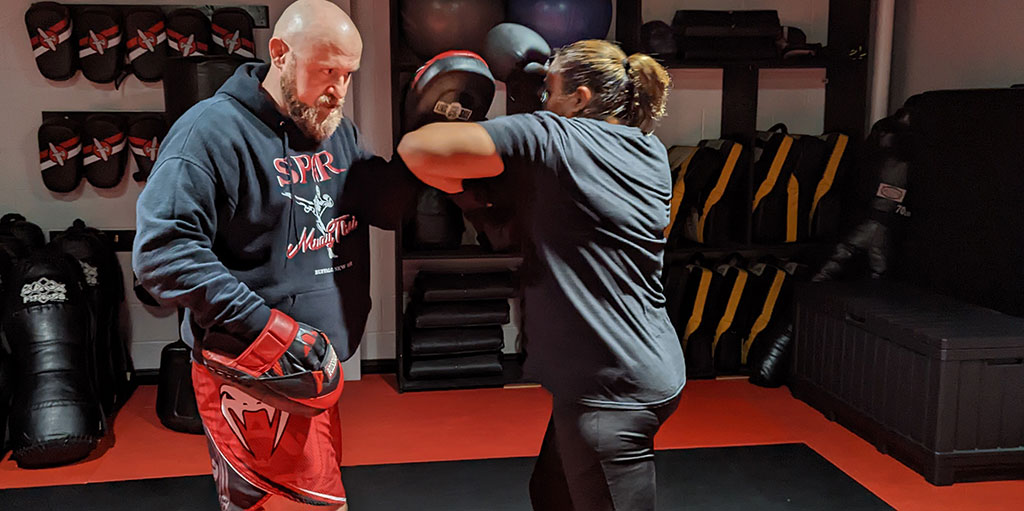
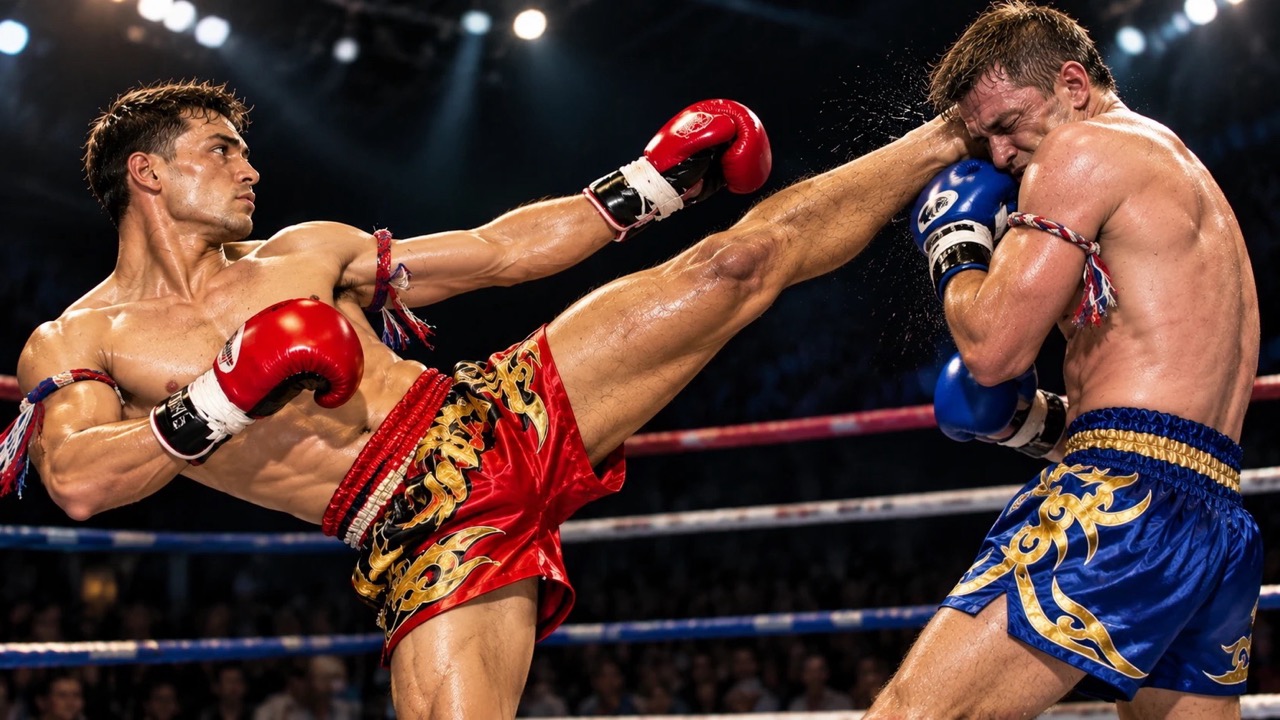
When most people think of Muay Thai, they think of its powerful kicks.
In this post, you’ll learn six different Muay Thai kicks and how to defend against each one.
About This Series
This is post 5 in my series covering THAI FIGHT’s “Muay Thai Tutorial” videos.
Earlier in this series: the Muay Thai stance and Wai Khru, Boxing Punches and how to defend them, Elbows and how to defend them, and Knees and how to defend them.
Each video is about two minutes long and taught in Thai. I’ll break down each lesson in plain English, step by step.
To see a low kick win a world title, read how Miguel Trindade won the GLORY featherweight title with the Inside Low Kick.
How This Post Works
For every kick you learn, I’ll also show you how to defend against it. That way, you’re learning both offense and defense.
You can also click any timestamp in this post to jump straight to that part of the video.
In this post:
Who Is Teaching?
Muay Thai champions Saenchai and Sudsakorn Sor Klinmee demonstrate the different kicks in a Muay Thai fighter’s arsenal. They also show you how to defend against each one.
The teep techniques are demonstrated by Sudsakorn Sor Klinmee, a highly accomplished Thai fighter who competed extensively in Thailand and internationally.
Sudsakorn began fighting at a very young age. He went on to win multiple championships, including WMC/S1 and WPMF world titles, and faced many top Thai and international fighters over hundreds of bouts.
The Six Muay Thai Kicks
- Leg Kick (Teh Kha /เตะขา)
- Body Kick (Teh Lam Tua /เตะลำตัว)
- High Kick (Teh Kan Kor /เตะก้านคอ)
- Jumping Kick (Kradot Teh /กระโดดเตะ)
- Teep (Teep Trong /ถีบตรง)
- Side Teep (Teep Khang /ถีบข้าง)
A Few Words You’ll Hear
- Kick, Teh (เตะ): a Round Kick, thrown with the shin.
- Teep (ถีบ): a straight push kick delivered with the foot. In Thai, Teep literally means “to push or shove away with the foot.” Fighters use it to create distance, stop an opponent from moving forward, or throw them off balance.
- Shin, Na Khaeng (หน้าแข้ง): the hard front of your lower leg. In Muay Thai, you throw a Round Kick with your shin, not your foot.
Saenchai fights from Southpaw Stance, so his Lead side is his right side. If you are right-handed, flip what you see.
Part 1: The Round Kick to the Leg, Teh Kha (เตะขา)
Watch it at 0:18
Saenchai says don’t throw this kick standing straight on. Your kick will have very little weight behind it.
- Step out a little to the side
- Angle your body off your opponent by stepping 45 degrees with your support leg
- Whip your shin down into the thigh of your opponent
Tip: chop downward into your opponent’s thigh instead of swinging your leg straight across. This angle helps you put more body weight and power behind your kick.
Whether your opponent stands Orthodox or Southpaw changes the target. If they are in the same stance as you, aim for the outside of the thigh. If they are in the opposite stance, aim for the soft fold on the inside of the thigh.
Why use this kick? Saenchai says low kicks work especially well against fighters who like to punch a lot. Repeated kicks wear down their legs, making them less willing to step forward and throw punches.
Defense: Stopping the Leg Kick
Watch it at 0:40
In this video, Saenchai demonstrates the Inward Lead Leg Shield, a defense against Low Kicks.
As the kick comes toward you, lift your Lead Leg and turn it slightly inward so your shin faces the kick.
The goal is to take the impact on the hard bone of your shin, not the softer muscle along the side of your lower leg.
Part 2: The Body Kick, Teh Lam Tua (เตะลำตัว)
Watch it at 0:38
Teh Lam Tua literally means “to kick the torso” in Thai.
- Lift your leg
- Turn your hip over
- Swing your shin up into the body
Saenchai demonstrates the Body Kick using both the Rear Leg and the Lead Leg. Your target is the ribs, just below your opponent’s arm.
The secret to a powerful Body Kick is staying loose and whipping your hips through the kick.
Keep your leg relaxed as you start, then turn your hip sharply to drive your shin into the target. Think of your leg like a whip. The power comes from the snap of your hips, not just swinging your leg.
Tip: stay loose until the moment of impact. If your body is too stiff, you lose speed and power. Let your hip lead the kick and your leg follow.
Saenchai also recommends practicing on the heavy bag. This helps you develop the timing, hip rotation, and power needed to make the kick effective.
To see Body Kicks and other Round Kicks at work in pro fights, read why Round Kicks still work in ONE Championship.
Defense: Stopping the Body Kick
Watch it at 0:40
Saenchai demonstrates the Rear Leg Outward Shield to block a Round Kick aimed at your ribs.
- Lift your Rear Leg up beside your body.
- Bring your elbow down toward your raised leg to create a strong shield.
- Keep your elbow on the outside of your thigh so your elbow and thigh don’t collide when the kick lands.
Tip: close the gap between your elbow and knee. Your arm and leg should work together as one solid shield. If you leave too much space, your opponent’s kick can slip through and hit your ribs.
Part 3: The High Kick, Teh Kan Kor (เตะก้านคอ)
Watch it at 0:39
Teh Kan Kor literally means “to kick the back of the neck” in Thai.
Like the Leg Kick, it has no power if you stand straight on your heel. Raise your heel off the ground and get tall, so you are up on the ball of your foot.
- Step out at a 45-degree angle with your support leg to open up your stance.
- Turn your hips as you throw the kick, aiming your shin at the side of your opponent’s neck.
- Let the kick follow through, allowing your leg to swing past the target and drop back down naturally.
Tip: stay loose as you throw the kick. Drive your shin upward and whip your hips through the target.
The power comes from opening your hips, turning your body, and letting the kick follow through. Don’t stop your leg at the point of impact.
This is similar to the High Kick Andre Fili used against Kai Kamaka.
Defense: Stopping the High Kick
Watch it at 0:40
Lean Back and Counter
Saenchai demonstrates a defense similar to “The Matrix” or “The Pull” in Western Boxing. Instead of blocking the High Kick, you make it miss completely.
- Lean your upper body backward as the kick comes toward your head.
- Step your rear foot back at the same time to create more distance.
- Let the kick sail past your face without making contact.
- Counter right away while your opponent is off balance.
Why does this work? When your opponent misses a powerful High Kick, the momentum can turn their body and leave them open.
Saenchai takes advantage of this by countering with a Body Kick, Leg Kick, or another striking technique as his opponent turns away.
Why Thai Fighters Prefer to Dodge High Kicks
In traditional Muay Thai, clean, powerful kicks are highly valued by judges. Even when you block a High Kick with your arms, a powerful kick that breaks through your guard or knocks you off balance can still score.
This is one reason many Thai fighters prefer to make the kick miss completely rather than absorb its power on their arms.
This differs from the Dutch Kickboxing style, where fighters often use a tight guard or cross their arms in an X-Block to defend against High Kicks.
You can see the X-Block in action in my breakdown of five kickboxing combinations.
Tip: making your opponent miss does more than protect your head. It can also create the perfect opening for a counterattack.
Part 4: The Jumping Kick, Kradot Teh (กระโดดเตะ)
Watch it at 0:39
Kradot Teh literally means “to jump and kick” in Thai. The Jumping Kick is similar to a Jumping Knee or Scissor Knee.
How to throw it:
- Bounce lightly on the balls of your feet to build rhythm and momentum.
- Lift your lead knee as if you’re throwing a Flying Knee. This helps disguise the Rear Round Kick and gets your body moving upward.
- Jump off your support leg and switch your legs in the air.
- Whip your Rear Leg into a Round Kick, aiming your shin at the side of your opponent’s head or neck.
- Turn your hips through the kick to generate power, then prepare to land with your balance under control.
Why use this kick? Saenchai makes an important point. A skilled opponent will often study videos of your previous fights. They learn your favorite techniques and prepare ways to defend against them.
The Jumping Round Kick works because it can catch your opponent by surprise. The jumping motion changes the angle and timing of your attack, making the kick harder to predict.
Saenchai explains that the kick doesn’t always have to knock someone out. Even if it doesn’t, it can knock them off balance or send them to the canvas.
Saenchai’s Famous Jumping Kick Variation
In the fight clips, you’ll see Saenchai use another version of this technique.
He brings his Lead Switch Kick toward his opponent’s thigh. He then uses that leg to push off the opponent’s thigh, launching himself into the air.
As he rises, he whips his Rear Leg upward, driving his shin toward his opponent’s head.
This is classic Saenchai: using timing, balance, and creativity to land a kick his opponent never expected.
Tip: the key is staying loose and explosive. Don’t try to muscle the kick. Use the jump to create height, then whip your hips and kicking leg through the target.
Part 5: The Teep, Teep Trong (ถีบตรง)
Watch it at 0:39
The Teep: Three Levels of Attack
Sudsakorn Sor Klinmee explains that the Teep is a straight Push Kick, almost like pushing open a door with your foot.
He demonstrates three different targets, each with its own purpose.
Level 1: The Thigh
Aim your Teep at the front of your opponent’s thigh.
- Strike with the ball of your foot, keeping your toes pulled back.
- Push straight into the thigh to stop your opponent from moving forward.
- Use it to break their rhythm and slow down their attacks.
Tip: kick your opponent’s shorts, where your foot cannot slide off. Thai fighters often rub boxing oil on their legs, making their legs slippery. Your foot can slide off their legs instead of landing a solid Teep.
Level 2: The Stomach
Use the same Teep, but aim higher at your opponent’s stomach.
- Lift your knee toward your target.
- Push your foot straight forward into the lower belly.
- Drive your hips forward to add power and push your opponent backward.
Tip: the Teep is not just a kick. It also helps you control distance, keep an aggressive opponent away, and create room for your next attack.
Level 3: The Face
The Face Teep is the highest and most difficult of the three.
- Lift your knee high, toward your hip or chest, almost like you’re throwing a Knee Strike.
- Keep your balance on your support leg.
- Extend your leg and push your foot toward your opponent’s face.
Side Note: Why Is a Teep to the Face Considered Disrespectful in Thailand?
There is an interesting part of Thai culture behind this technique.
In traditional Thai beliefs, the head is considered the most sacred part of the body, while the feet are considered the lowest and least clean.
Because of this, placing the bottom of your foot against someone’s face can be seen as a serious insult.
These beliefs are part of Thai culture and are influenced by Buddhist traditions and older Thai spiritual customs.
Although the Face Teep is used in professional Muay Thai fights, many Thai fighters consider it disrespectful during friendly sparring.
The lesson: just because a technique is allowed in competition doesn’t mean it’s appropriate to use on your training partners.
Defense: Stopping the Teep
Watch it at 0:40
Three Ways to Defend the Teep
Sudsakorn Sor Klinmee demonstrates three different ways to defend against the Teep, depending on whether your opponent aims for your thigh, stomach, or face.
Level 1: Defending the Thigh Teep
The easiest way to stop a Thigh Teep is to make it miss.
- Pull your Lead Leg back as your opponent throws the Teep.
- Step backward just enough so their kick falls short.
- Counter with a Switch Kick as your opponent brings their leg back down.
I like to call this movement a “Square Out.” You’re simply pulling your leg out of the way so your opponent kicks into empty space.
Tip: don’t step back farther than you need to. Stay close enough to counter right away.
Level 2: Defending the Stomach Teep
Sudsakorn uses a Triangle Step and a downward parry to redirect the kick.
- Step at a 45-degree angle to move your body off the line of the kick.
- Use your lead hand to parry, keeping your fingers pointed downward.
- Guide the kick past your body instead of trying to stop it with force.
- Keep your other hand up to protect your head.
I like to call this a “Kung Fu Block” because you can find similar blocking movements in traditional Kung Fu.
Tip: the Triangle Step and parry should happen at the same time. Move your body out of the way while your hand redirects the kick.
Level 3: Defending the Face Teep
For the Face Teep, Sudsakorn uses a similar Triangle Step, but changes the direction of his hand.
- Step at a 45-degree angle to move your head off the line of the kick.
- Raise your lead hand with your fingers pointing upward, like a basic Inward Parry.
- Slap the tip of your opponent’s foot to the side as the kick comes toward your face.
- Keep your other hand up to protect your head.
Tip: don’t rely on your hand alone to stop a Face Teep. Move your head off the line first, then use a quick parry to guide the foot past you.
Remember: the goal of all three defenses is the same. Make your opponent miss, stay balanced, and put yourself in a good position to counterattack.
Part 6: The Side Teep, Teep Khang (ถีบข้าง)
Watch it at 0:37
Teep Khang literally means “to push or kick sideways with the foot” in Thai.
Side Teep: Three Levels of Attack
The Side Teep can be thrown at three different levels, just like the regular Teep. The biggest difference is that you strike with your heel instead of the ball of your foot.
Lead Leg Side Teep
- Use a Pendulum Step to bring your rear foot closer to your lead foot, helping you close the distance.
- Turn your body sideways so your hip points toward your opponent.
- Drive your heel straight forward, pushing through the target.
Rear Leg Side Teep
- Swing your Rear Leg across your centerline to set up the kick.
- Turn your hips and body sideways as you bring your knee toward the target.
- Drive your heel forward, extending your leg into your opponent.
Where to Aim: Three Levels
- Thigh: target the front of your opponent’s thigh to stop their forward movement and break their rhythm.
- Stomach: drive your heel into the lower belly. A powerful Side Teep to the stomach can knock the wind out of your opponent.
- Face: lift your knee higher and extend your heel toward your opponent’s face.
Tip: the power of the Side Teep comes from driving your hips behind your heel. Don’t just lift your leg and push. Turn your body sideways, keep your balance, and drive through the target.
Defense: Stopping the Side Teep
Watch it at 0:42
The defenses match the straight Teep. Step back from the low one, and slap the middle and high ones away with your hand.
Common Kicking Mistakes I See
These are the mistakes I see most with new students.
- Kicking with the foot. Your foot is full of small bones. Kick with your shin.
- No hip turn. The power comes from turning your hip over, not from your leg alone.
- Hands dropping. Your guard stays up while you kick. A dropped hand is an open door.
- Standing straight on. When throwing a Round Kick, don’t stand directly in front of your opponent. Step out at a 45-degree angle to open up your hips and put more power behind your kick. This angle also moves you away from your opponent’s Straight Punches, making it harder for them to counter.
How to Start Training Muay Thai in Portland
Ready to start learning Muay Thai? Here’s how to get started, step by step.
- Watch the videos. Pick one kick and one defense. Watch them a few times so you understand how each technique works.
- Practice slowly. Start by throwing the kick in the air. Focus on your balance, hip rotation, and keeping your hands up. Good technique comes before speed and power.
- Train with a coach. Videos are a great way to learn, but they can’t tell you what you’re doing wrong. A coach can watch you and correct your mistakes.
- If you’re in the Portland, Oregon area, reach out to me when you’re ready. Use the contact form on TrainWithSean.com.
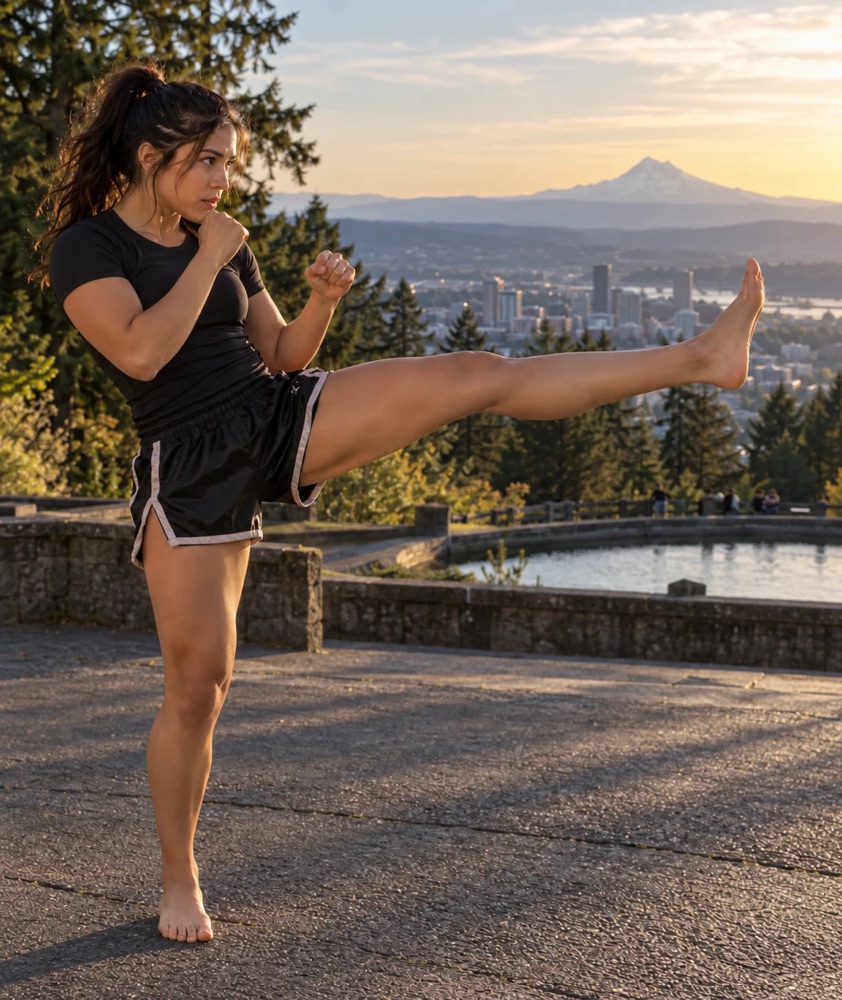
Learn Muay Thai Kicks With a Coach in Portland
Saenchai and Sudsakorn demonstrate six Muay Thai kicks and how to defend against each one. These short videos are packed with useful techniques you can add to your training.
Videos are a great way to learn, but they can only show you how a technique is done. They can’t watch you practice, spot your mistakes, or help you correct them.
That’s where training with a coach makes a difference. In a private lesson, I’ll help you improve the details that make your kicks more powerful and effective, including your balance, hip rotation, shin position, footwork, guard, and how quickly you return to your fighting stance.
I’ve been a Certified Muay Thai Instructor since 1997, and I teach Muay Thai private lessons in Portland, Oregon.
Whether you’re a complete beginner or have years of experience, I’ll work at your pace.
Coach Sean Haley
TrainWithSean.com