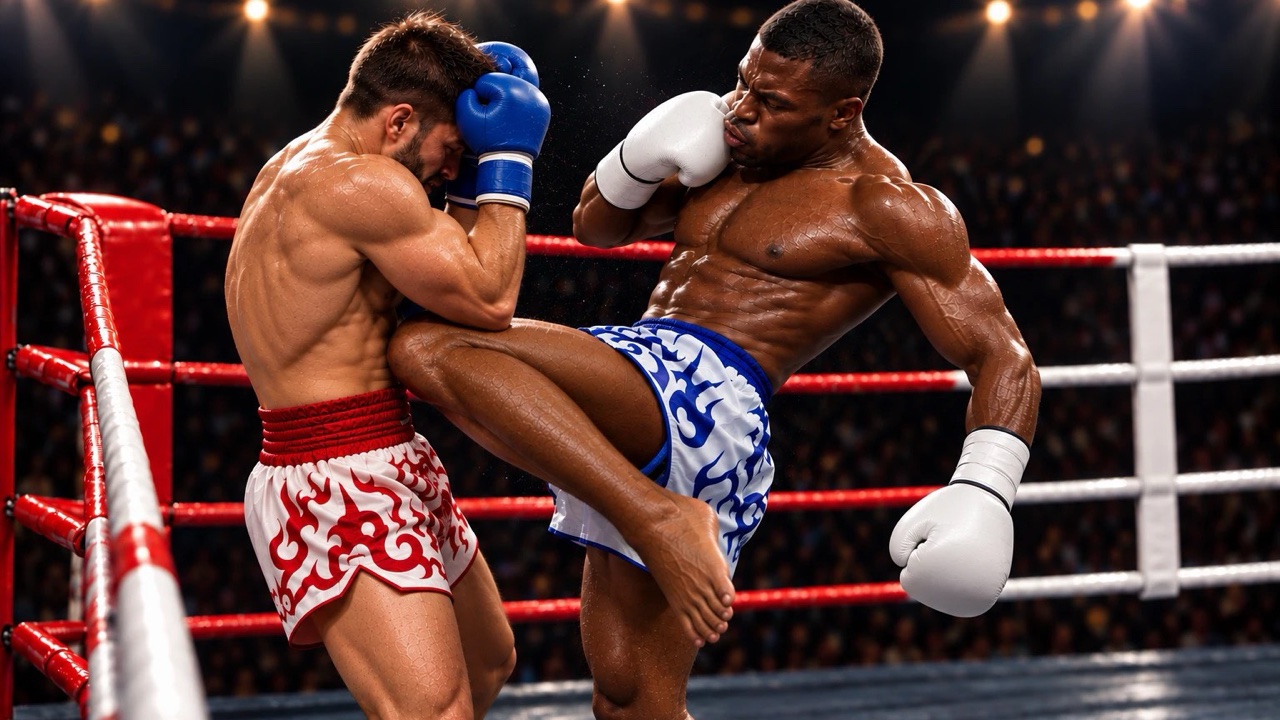
A good Knee can end a fight in one shot. Muay Thai knees are short, hard, and very hard to see coming.
This is post 4 in my series on THAI FIGHT’s “Muay Thai Tutorial” videos. Each video is about two minutes long and spoken in Thai. I’ll walk you through what is taught, in plain English.
Earlier in this series: the Muay Thai stance and Wai Khru, punches and how to defend them, and Elbows and how to defend them.
This time the teacher is Sudsakorn Sor Klinmee. He shows three Knees and a defense for each one, across six short videos. Click any timestamp, and the video in the post jumps to that moment.
In this post:
Who Is Sudsakorn Sor Klinmee?
Sudsakorn Sor Klinmee is an experienced Muay Thai fighter from Pattaya, Thailand. Born in 1986, he has competed in more than 350 fights throughout his career.
He is a former THAI FIGHT Kard Chuek Middleweight Champion. Kard Chuek is a traditional form of Muay Thai where fighters wrap their hands in rope instead of wearing boxing gloves.
Sudsakorn also won a WKN Muay Thai World Championship. In 2011, he faced Giorgio Petrosyan, widely considered one of the greatest kickboxers of his generation.
Three Muay Thai Knee Strikes Covered in This Series
- Straight Knee — Khao Trong (เข่าตรง)
- Diagonal Knee — Khao Chiang (เข่าเฉียง)
- Flying Knee — Khao Loi (เข่าลอย), also called a Jumping Knee
One Word You’ll Hear
- Knee, Khao (เข่า): the strike itself. Thai fighters hit with the point of the knee, driven by the hips.
The Straight Knee, Khao Trong (เข่าตรง)
Watch Sudsakorn throw it: 0:40
The Straight Knee is the first Knee most students learn. It goes straight forward into your opponent’s stomach or ribs.
- Step in
- Lift the Rear Knee
- Drive your hips forward
(Tip: point your toes down as the Knee comes up. Sudsakorn says that if you pull your toes up, the Knee loses power.)
Sudsakorn aims at the middle of the body, just under the ribs. He says to push your hips forward at the same moment the Knee lands.
The hips and the Knee move as one beat, not two, and that is where the power comes from.
Defense: Stopping the Straight Knee
Sudsakorn shows two ways to stop a Straight Knee.
Method 1: Block with Knee
Watch it at 0:39
- Lift your leg to check the incoming knee strike.
- Turn your body slightly to the side, then use a motion similar to a Curved Knee.
- Aim to land your knee on your opponent’s thigh as they throw their knee strike.
- Stiff Arm their chest with your same side arm.
(Tip: a small turn is enough. You only need to move the knee a few inches.)
Method 2: Block with Your Elbow
- As your opponent’s Knee comes up, bring your Elbow down to block it.
- Drive your Elbow into the front of their thigh.
- Keep your guard up to protect your head.
- Use your other arm to stiff-arm their chest and keep them away and off-balance them.
Sudsakorn explains that this defense also hurts your opponent. Instead of their Knee hitting your body, their thigh runs into the hard point of your Elbow.
The Diagonal Knee, Khao Chiang (เข่าเฉียง)
Watch Sudsakorn throw it: 0:37
The Diagonal Knee comes in at an angle instead of straight ahead. It aims at the side of your opponent’s body, around the lower ribs.
- Step in
- Lift the Knee
- Turn it in at an angle to the ribs
Tip: Keep your Knee pointed to make the strike more effective. Sudsakorn explains that when your technique is correct, the power comes naturally.
Sudsakorn says the most important thing is simple: your hands do not drop. Keep your Lead Hand up to block while the Knee goes in.
Many fighters throw a good Knee and get hit coming out of it. A guard that stays up keeps that from happening.
Defense: Stopping the Diagonal Knee
Watch it at 0:39
Similar to defending the Straight Thrust Knee, you use your own Knee to block the Diagonal Knee.
- Lift your leg into your normal checking position.
- Turn your body slightly so your raised Knee meets the attack coming in from the side.
- Check on the same side as the attack. If the Knee comes from your left, check left. If it comes from your right, check right.
Sudsakorn compares this defense to a spear. Drive your raised Knee into the top of your opponent’s thigh. This stops their Knee before it reaches your ribs and can hurt your opponent at the same time.
The Flying Knee, Khao Loi (เข่าลอย)
Watch Sudsakorn throw it: 0:38
For most knee strikes, you step forward to close the distance. With the Flying Knee, you jump instead. Push off with one leg, then switch legs in the air to drive your other knee upward. This move is sometimes called the Scissor Knee because of the way your legs switch positions in the air.
- Lift one leg
- Jump and switch legs
- Drive the other Knee up
When to Throw It
Sudsakorn aims the Flying Knee at the chin or the face. The best time is when your opponent is walking in toward you.
As they close the distance, you meet them on the way in. Their own step adds to the power of your Knee.
For a Flying Knee in a real fight, see how Johnny Walker used one to set up his Thai Clinch knee KO at UFC 332.
Defense: Stopping the Flying Knee
Watch it at 0:38
Sudsakorn says not many fighters use the Flying Knee. Watch for the first Knee lift. This tells you the Flying Knee is coming. If they lift their right Knee first, their left Knee is the one coming toward you.
- Step off the line of attack using a 45-degree Triangle Step.
- Stiff arm your opponent’s chest as you step to the side, pushing them away while they are in the air.
- Keep your other hand glued to your head to protect yourself from the Knee.
Tip: Aim your stiff arm at your opponent’s chest, not their shoulder. The chest is a bigger target and easier to push. Even a small push while your opponent is in the air can throw them off balance and take power away from their Flying Knee.
Common Muay Thai Knee Mistakes I See
These are the mistakes I see most with new students throwing Muay Thai knees.
- Toes pulled up. Point your toes down. It locks your leg and puts the point of the Knee forward.
- No hips. A Knee thrown with only the leg is weak. Push your hips forward as it lands.
- Hands dropping. Your guard falls the moment your Knee goes up. Keep at least one hand if not both at eye level.
- Leaning back. Many beginners lean away from their own Knee. Stay tall and move into it.
How to Start Training in Portland
Here is how to get started, step by step:
- Watch all six videos. Pause on each Knee and copy it slowly in front of a mirror.
- Practice the Straight Knee first. Get your toes, hips and guard right before you try the others.
- If you’re in the Portland, Oregon area, reach out to me when you’re ready. Use the contact form on TrainWithSean.com.
Learn Muay Thai Knees With a Coach
The Straight Knee targets the stomach. The Diagonal Knee attacks the ribs. The Flying Knee can reach the chin. Each strike has a defense, whether you use a check, a block, a parry or a push.
A video can show you how to throw a Knee, but it can’t watch you practice or correct your mistakes.
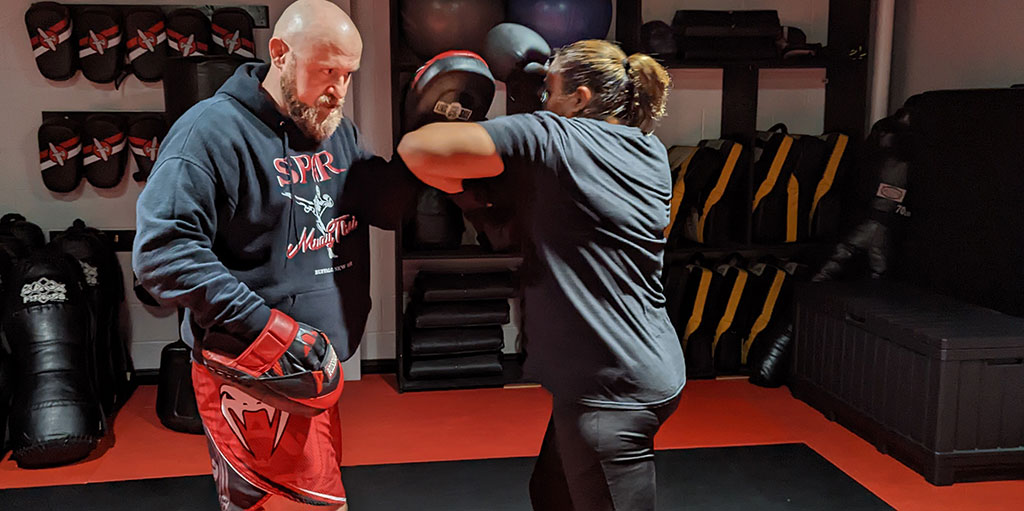
In a private lesson, I hold the pads while you practice each Knee. I watch your foot position, your hips and your guard. I also throw strikes back at you, so you learn how to defend against each one.
I’ve been a Certified Muay Thai Instructor since 1997, and I teach Muay Thai private lessons in Portland, Oregon.
If you want to improve your Muay Thai, private lessons give you the chance to work on both your strikes and your defense with a coach who can correct you as you train.
Next in this series: Muay Thai Kicks and how to defend against them.
Coach Sean Haley
TrainWithSean.com