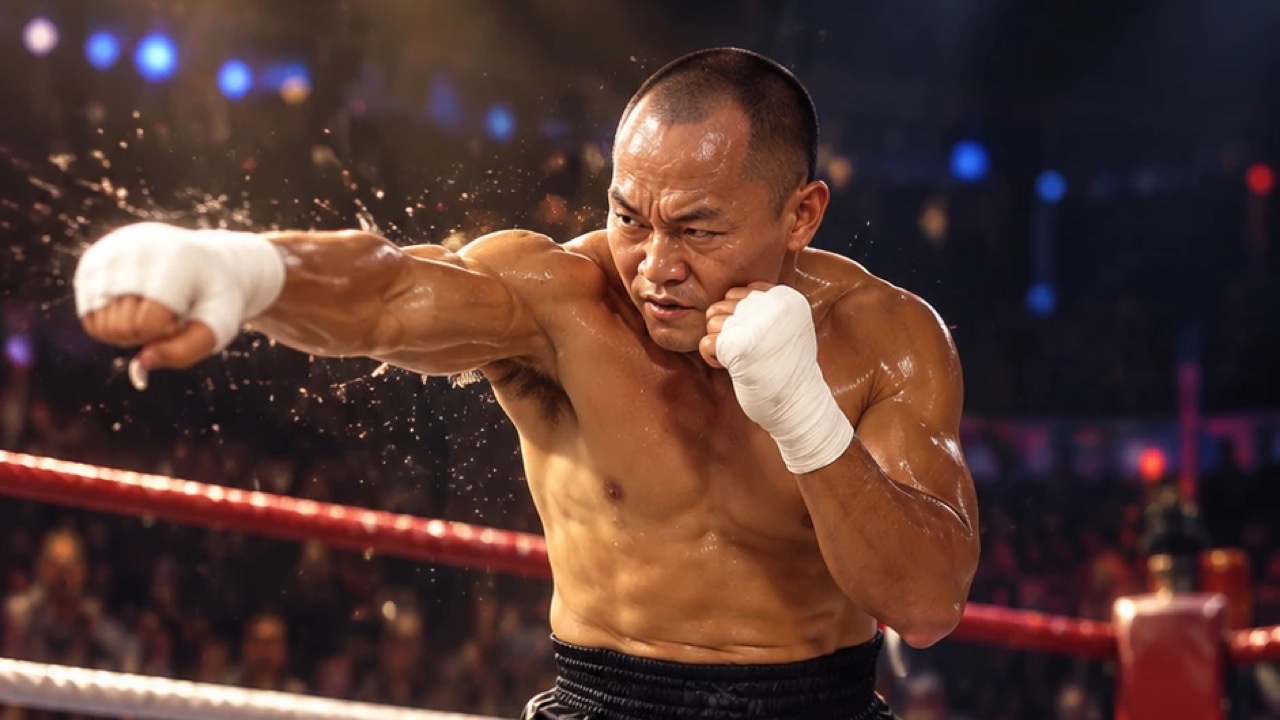
Muay Thai has eight weapons, and the hands are where most people start. There are five Muay Thai punches, and each one has its own job.
This is the second post in my series built on THAI FIGHT’s “Muay Thai Tutorial” videos. The first post covered the Wai Khru and the Muay Thai stance, taught by Saenchai. Your stance comes first, because every punch starts and ends there.
Each punch below sits right next to its defense. Click any timestamp, and the video in the post jumps to that moment. For the short codes I use for each punch in my notes, see my Muay Thai shorthand key.
The Five Muay Thai Punches
- Jab (Mat Krathaek /หมัดกระแทก)
- Cross, or Straight Punch (Mat Trong /หมัดตรง)
- Hook (Mat Tat /หมัดตัด)
- Uppercut (Mat Ngat /หมัดงัด)
- Overhand, or Swing Punch (Mat Wiang /หมัดเหวี่ยง)
One Word You’ll Hear
- Parry: a small slap that knocks a punch off its line.
1. The Jab (Mat Krathaek /หมัดกระแทก)
Watch it at 0:12
The Thai name means “the jolting punch.” The Jab comes from your Lead Hand, the hand closest to your opponent.
Saenchai is honest about it: your Lead Hand is not as strong as your Rear Hand. The Jab’s main job is to break your opponent’s rhythm.
Land it on a good spot, and it still stings. Then follow it right away with another weapon, like a Kick or a Knee.
- Jab to break the rhythm
- Then follow with a Kick, a Knee or a Cross
Defending the Jab
Watch it at 0:38
The Jab is aimed at your face. Bring your Lead Hand in toward the center, just a little, and catch the punch.
Saenchai says to move like a snake: small and quick. Keep your eyes on your opponent the whole time.
Once you catch the Jab, you are ready to punch right back with a Cross or a Jab.
2. The Cross, or Straight Punch (Mat Trong /หมัดตรง)
Watch it at 0:12
The Cross comes from your Rear Hand, and it is your power punch. Saenchai gives a few clear points:
- Don’t lift your Rear Leg off the floor, or you lose your balance
- Turn your Rear Leg and twist your hips a little
- Land with the front of your fist
- Aim at face height, not too high and not too low
You can also throw it to the body. Bend your knees a little to drop your level, then punch straight into the stomach.
Defending the Cross
Watch it at 0:37
Bring both hands to the center of your face, one in front of the other, like an X. Your Lead Hand turns the punch, and your Rear Hand backs it up.
Tuck your chin down a little. If one hand misses, the other hand still catches the punch.
Most of all, don’t close your eyes. If you close your eyes, your opponent can keep throwing, and you won’t see what’s coming next.
3. The Hook (Mat Tat /หมัดตัด)
Watch it at 0:12
The Thai name means “the cutting punch,” because the Hook cuts in from the side. The power comes from turning your shoulder into it.
Keep the Hook at face level, not too long and not too short. Your target is the side of the face or the chin.
Saenchai likes to Hook just as the opponent steps in to Kick or Knee. You can also take it to the body, along the side of the ribs.
Defending the Hook
Watch it at 0:40
Raise your arm fast, with your hand up by your head, to cover your chin. Hide your chin behind your shoulder (sometimes referred to as Long Guard).
Keep your eyes on your opponent the whole time, so you see the Hook as it starts.
4. The Uppercut (Mat Ngat /หมัดงัด)
Watch it at 0:22
The Thai name means “the prying punch,” because it comes up from underneath. Your target is your opponent’s chin.
Drop your hand down a little first, then drive it straight up. Shift your body behind it, so your weight goes into the punch.
Defending the Uppercut
Watch it at 0:39
Bring your Lead Hand down to the center, palm turned up, and catch the Uppercut gently. Don’t slap at it hard.
Keep your elbow in, too. A tight elbow blocks the punch before it reaches your chin.
5. The Overhand, or Swing Punch (Mat Wiang /หมัดเหวี่ยง)
Watch it at 0:13
The Swing Punch (aka Overhand Punch) loops over the top, with your fist turned over. Your target is the side of the face, and you swing it with full power.
Saenchai shows a smart setup. Dip forward first, so your opponent thinks a straight punch or a body punch is coming. Then swing up and over the top.
Defending the Overhand
Watch it at 0:45
Similar to the Long Guard defense covered earlier, raise your arm to protect the side of your head while keeping your eyes on your opponent. If your opponent throws a big, looping Overhand Punch, bring both hands up to protect your head.
Saenchai explains that it doesn’t matter how big or strong your opponent is. Using the right defense and keeping your hands in the proper position can help protect you from a powerful Overhand Punch.
Why Every Muay Thai Punch Comes With Its Defense
Every punch you throw opens a door for your opponent. Learning the defense right next to the punch teaches you both sides of that door.
It also builds good habits early. You learn to punch with your eyes open, your chin down, and your other hand glued to your chin.
How to Start Training in Portland
Here is how to get started, step by step:
- Watch the videos in pairs. Watch each punch, then its defense.
- Shadowbox slowly. Throw each punch in front of a mirror, then practice the defense.
- If you’re in the Portland, Oregon area, reach out to me when you’re ready. Use the contact form on TrainWithSean.com.
Learn Muay Thai Punches With a Coach
Watching these videos is a great way to learn the different punches used in Muay Thai. But watching a punch and learning how to use it are two different things.
That’s where training with a coach can help.
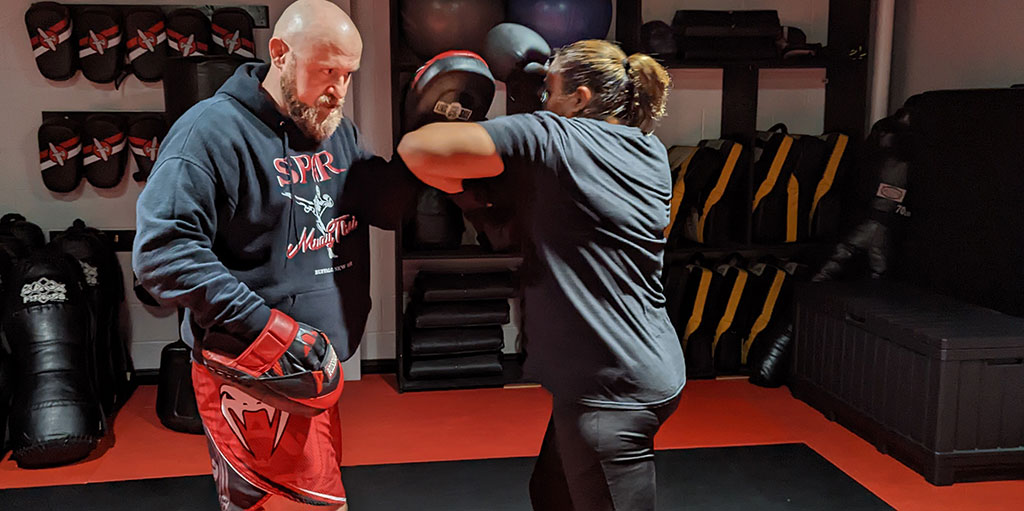
In my private Muay Thai lessons, we’ll work on the focus mitts to help you punch with more speed, power, and accuracy. I’ll also throw punches back at you so you can practice blocking, moving, and defending yourself.
Every lesson is built around your skill level and goals. Whether you’re brand new to Muay Thai or have trained for years, I’ll help you improve one step at a time.
I’ve been a Certified Muay Thai Instructor since 1997, and I now teach private Muay Thai lessons in Portland, Oregon.
Do you live in the Portland area and want to take your Muay Thai skills to the next level? Visit TrainWithSean.com to learn more about private lessons with me.
Next in this series: Muay Thai Elbows and How to Defend Them.
Coach Sean Haley
TrainWithSean.com