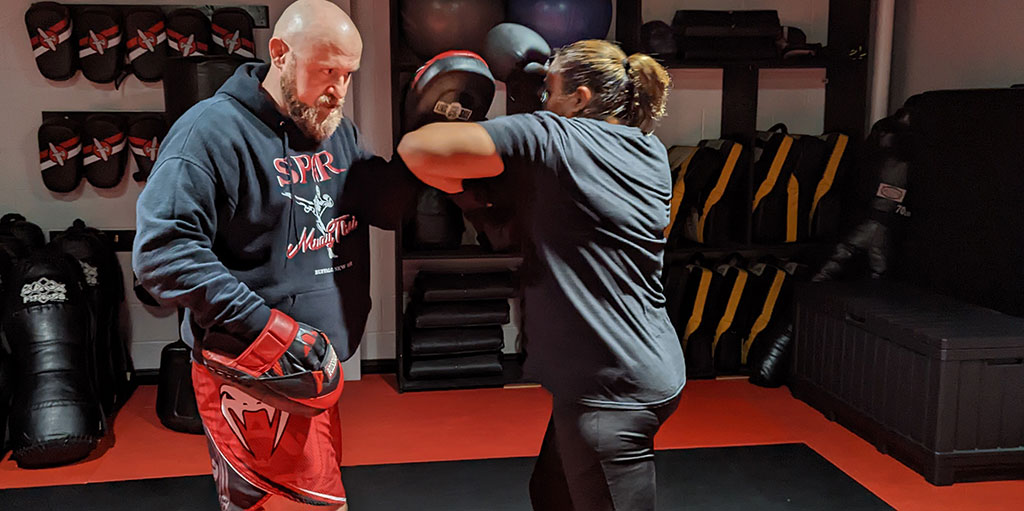
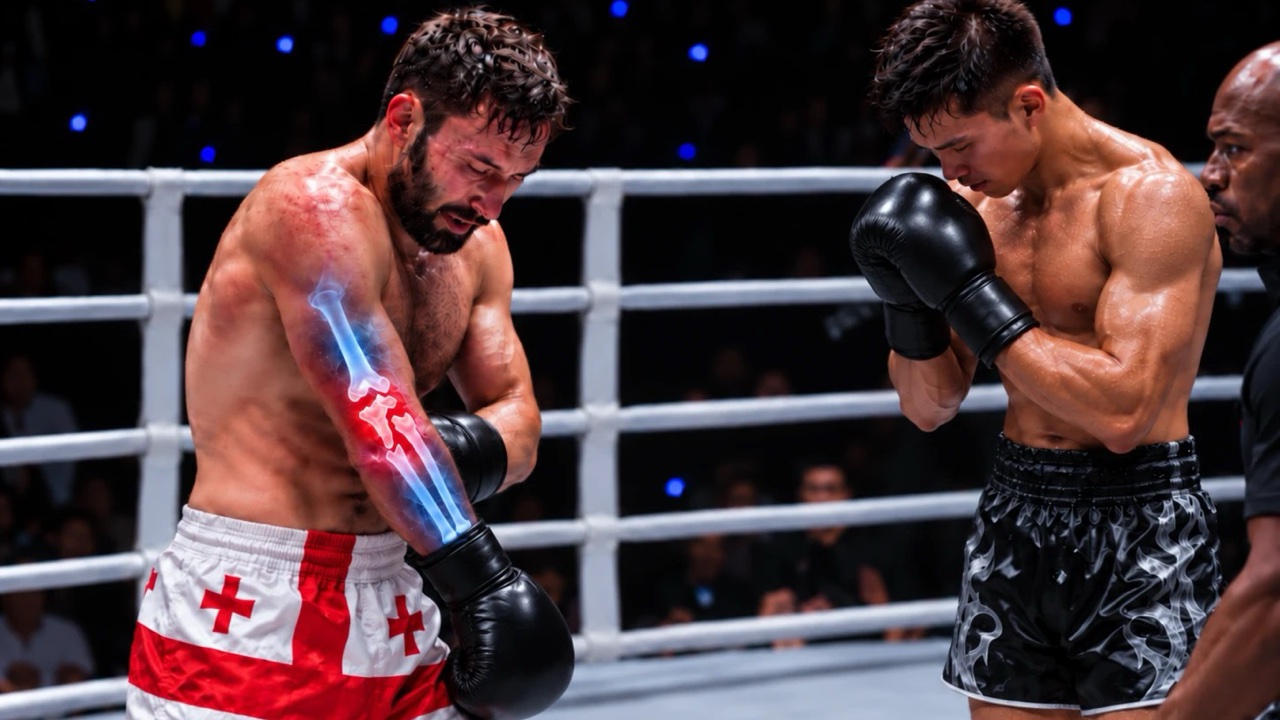
Top photo: AI-generated art.
Tawanchai vs. Davit Kiria at ONE Fight Night 13 showed that a blocked kick is not always a stopped kick. Tawanchai PK.Saenchai broke Davit Kiria‘s arm right through his guard with a Round Kick (Teh / เตะ).
The fight took place in August 2023 at Lumpinee Boxing Stadium in Bangkok, Thailand. Tawanchai held the ONE Featherweight Muay Thai World Championship and was making his kickboxing debut in ONE.
Kiria came in as a former GLORY Lightweight World Champion from the country of Georgia. Going into this fight, he was known as a strong, forward-moving puncher with real knockout power.
Early in the third round, one more Round Kick landed on Kiria’s arm and ended the fight.
Watch the Full Fight: Tawanchai vs. Davit Kiria
Video: ONE Championship on YouTube.
The knockout and the slow-motion replay start at 6:29.
When you watch, you’ll hear the referee say “Chok” (ชก). It means “fight” in Thai and tells the fighters to start or keep fighting.
ONE Championship Kickboxing Rules: Why There Is Little Clinching
In both GLORY and ONE Championship kickboxing, fighters can’t clinch for long the way they can in traditional Muay Thai.
GLORY lets a fighter clinch briefly and throw one Knee, then let go of the opponent right away.
ONE Championship is stricter about clinching, and referees will separate fighters who tie up.
That’s why most of the action in these kickboxing matches is punches, kicks, and knees, without long clinch exchanges.
For combinations that work under these rules, read my post on kickboxing combinations for beginners.
How Tawanchai Used His Rear Round Kick
Tawanchai fights from a Southpaw Stance, so his Left Leg is his Rear Leg. He throws that Rear Round Kick hard and often.
Kiria pressed forward to close the distance and land punches. Tawanchai kept him at bay by staying mostly at kicking range.
He used the Teep (Teep /ถีบ) to keep Kiria away. He also punished him with Round Kicks to the legs, the body, and the head.
Most of those kicks went to the body. Kiria held his hands high to protect his ribs, so his right forearm took much of the impact.
Kiria was starting to get his boxing working by crowding and smothering Tawanchai. By the end of the second round, though, his right arm had taken a lot of punishment.
The Kick That Ended the Fight
Just 29 seconds into the third round, Tawanchai threw another Rear Round Kick.
Kiria raised his right arm to block it, and the impact broke his forearm.
Kiria turned away at once and showed that something was wrong with his arm. Referee Olivier Coste stopped the fight, and Tawanchai won by TKO in the third round.
Reports after the fight confirmed that Kiria’s right forearm was broken. Tawanchai later went to Kiria and apologized for the injury.
In the ring, Tawanchai said attacking the arm was the plan with his team. “We know that his arm was one of the weaknesses,” he said through an interpreter.
Official Result: Tawanchai PK Saenchai defeated Davit Kiria by TKO (arm injury), Round 3, 0:29, at ONE Fight Night 13.
Why Blocking a Round Kick Can Still Hurt
Many people think a kick is fully defended if it lands on the arms instead of the body, but it isn’t.
Blocking a Round Kick with your forearm can protect your ribs, but it doesn’t stop the impact.
A good Muay Thai Round Kick lands with the shin. The supporting foot turns, the hips turn over, and the whole body drives the kick.
When a fighter takes those kicks on the same arm again and again, the damage adds up.
That is what made Tawanchai so hard to deal with. He kept throwing his Rear Round Kick, even when Kiria’s arm blocked it. Every block still cost Kiria another hard hit to the same arm.
For more on how the great kickers turn the hip over, read my post on Saenchai’s Muay Thai kicks.
What You Can Take Into Your Own Training
A kick doesn’t need to land cleanly on the body to work. Tawanchai’s Rear Round Kick did two jobs in this fight.
- It kept a puncher away: Kiria had to get through the kick to reach punching range.
- It punished the guard: every arm block took a little more out of Kiria’s arm.
Kiria is a world-class fighter, and I’m not going to tell him what he should have done. For students, though, this fight raises a good question. What can you do when a kick keeps landing on the same arm?
Here are a few options to work on in training.
- Check the Kick with Your Shin: Traditional Muay Thai teaches fighters to check kicks with the shin instead of taking them on the arms. Against Tawanchai, that would have been hard to pull off. His kicks landed high on Kiria’s body and arms, so a Leg Check would have needed a very high knee and excellent timing. Even then, it would not have been a sure defense. To learn the shin check, read the Defense: Stopping the Body Kick part of my Saenchai kicks post.
- Use an X-Block: Dutch-style kickboxers often use an X-Block to defend against Round Kicks. Instead of taking the kick on one arm, you bring both forearms together to spread out the impact. You keep both feet planted and can counter quickly with punches. Even so, your arms still absorb much of the kick’s force, as Kiria found out.
- Move Off the Line of Power Against a Southpaw: Tawanchai fights from a Southpaw Stance, meaning his Rear Round Kick comes from his left leg. Moving to the left can take an opponent off the direct line of that kick. It forces Tawanchai to adjust his angle and can reduce the impact if the kick still lands. Against an Orthodox fighter, moving to the right serves a similar purpose against their Rear Round Kick. In both cases, lateral movement and footwork can make it harder for a fighter to land their power kicks cleanly.
- Answer Back with Punches: Stepping in with punches after defending a kick can make a fighter think twice before throwing it again. Of course, this is easier said than done against an experienced kicker like Tawanchai, who is skilled at controlling distance and timing his attacks.
- Catch the Kick with an Overhook and Counter: Trap the kicking leg under your arm and control it for a moment. Then push it away and counter with a punch. This was a kickboxing match, not a Muay Thai bout, so a catch-and-sweep was not an option for Kiria. Any catch also has to follow the event’s rules on holding an opponent’s leg.
Every fight is different, and there is no one right answer. These are simply ideas to practice with your coach.
To see how other fighters use Round Kicks under ONE’s Global Muay Thai rules, read my post on Muay Thai Round Kicks in ONE Championship.
One Kick, Thrown Again and Again
Kiria protected his ribs and was starting to find his boxing, but in the end, Tawanchai’s kicks were too much for him. Tawanchai won with good technique, good timing, and one kick he kept throwing until it broke through.
Want to build a Round Kick like this? My Muay Thai private lessons in Portland, Oregon work on kicking technique and timing. We also work on how to defend kicks.
If you’re in the Portland, Oregon area, reach out to me when you’re ready. Use the contact form on TrainWithSean.com.