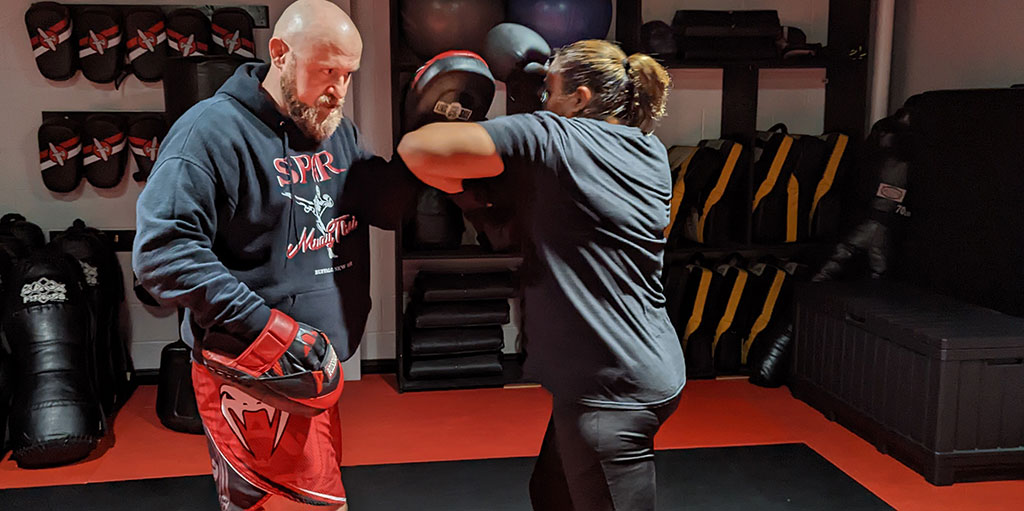
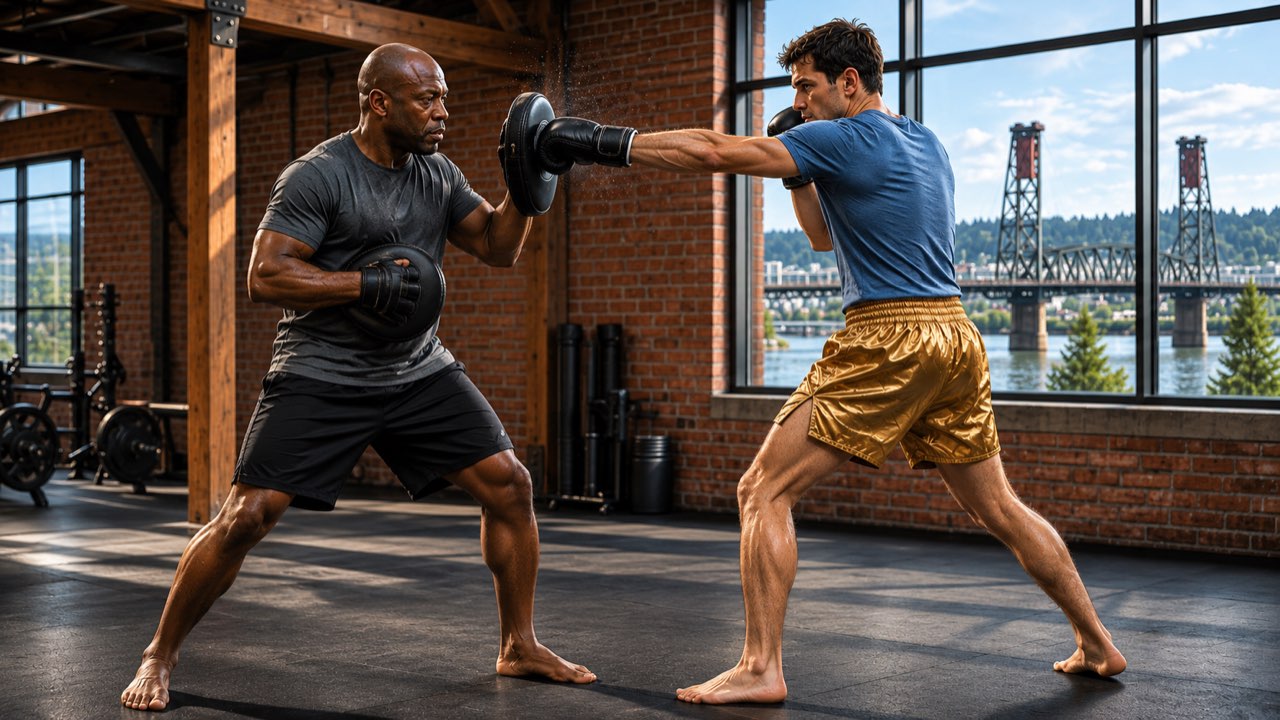
The Jab and Cross are usually two of the first punches you learn in Muay Thai and Boxing. While both punches are fairly easy to understand, developing proper technique takes practice. Even experienced students can develop bad habits without realizing it.
Some of the most common mistakes include standing too far from your target, leaning forward when punching, or failing to fully extend your arm. These mistakes are easy to overlook, especially when you’re focused on hitting harder or faster.
Let’s look at five common mistakes and how to correct them.
In the video below, Coach Leandro Longo of Maximum Boxing in Brazil shows each one with professional fighter Matheus Munhoz.
This is Part 3 of my Straight Punch Series:
- Part 1: How to Throw a Straight Punch covers how to make a proper fist and throw a straight punch.
- Part 2: Muay Thai 1-2 Combo explains why the Jab and Cross can look different in Muay Thai and Boxing.
In this post:
The Video: How to Throw the Jab and Cross Correctly
Watch for the five mistakes as Matheus shows the wrong way first, then the fix.
Video courtesy of the Maximum Boxing YouTube channel.
Mistake 1: Punching From Too Far Away
Watch the demonstration: 1:28
The Jab (Mat Yaep / หมัดแย็บ) and Cross (Mat Trong / หมัดตรง) are straight punches, but they can only reach so far.
One mistake beginners make is trying to hit a target that’s outside their punching range. They stretch their arms or reach by bending at the waist, hoping to make contact.
The problem isn’t necessarily the punch. It’s the distance.
The Fix: Use Your Footwork to Close the Distance
If you’re too far away, take a short step forward with your Lead Foot as you throw your Jab. Keep the step controlled and close to the floor. Then bring your Rear Foot with you so your feet don’t end up too far apart.
Watch Matheus in the video. He closes the distance with his Jab, gets into position, and follows with his Cross.
With practice, you’ll get better at judging whether you’re close enough to land before you throw.
Mistake 2: Leaning Forward With Your Head
Watch the demonstration: 3:13
Coach Longo points out another habit: beginners sometimes push their head and chest forward as they punch.
This may help them reach a little farther, but it creates new problems. Their weight shifts too far over the Lead Foot, making it harder to stay balanced or recover after the punch. It also makes it difficult to rotate their body effectively.
In Muay Thai, that position can be especially risky. You may be slow to defend a counterattack or follow up with a Kick or Knee.
For how to defend the Jab and Cross, see my guide:
Muay Thai Punches and How to Defend Them
The Fix: Keep Your Head and Body Balanced
Don’t lean forward as you punch. Keep your back straight.
Keep a stable stance and let your shoulders turn naturally. Don’t let your head drift in front of your feet. If you’re struggling to make contact, adjust your position instead of stretching your body toward the target.
Mistake 3: Punching With a Bent Arm
Watch the demonstration: 3:50
Some beginners make contact with their Jab or Cross too soon. Their elbow is still clearly bent when the punch reaches the target.
That shortens the punch and makes the strike land with less force.
The Fix: Extend Your Arm Toward and Through the Target
Send your fist straight at the target. Let your arm reach nearly full extension as the punch lands. The movement should continue into the target rather than stop short of it.
This doesn’t mean forcing your elbow to lock. Keep your fist, wrist, and forearm aligned, and keep your opposite hand near your face to protect your jaw.
You get a solid punch by keeping your upper body aligned and straight.
Mistake 4: Not Rotating Your Fist and Elbow
Pay attention to Matheus’s fist as he throws his Jab and Cross. As his arm extends, he gradually rotates his fist until his palm faces down.
You want your fist to be horizontal, like Matheus is teaching. A common mistake is leaving the fist in a vertical formation throughout that movement or twisting it abruptly at the end.
Matheus also points out a second detail: the elbow. In your guard, your elbow points down. As you punch, your elbow turns out as your fist turns, so it lines up behind the punch. The elbow turns, but it doesn’t swing out to the side.
The Fix: Turn Your Fist and Elbow as Your Arm Extends
Matheus shows the same movement with both punches. For the Jab:
- Start in your fighting stance with your hands up to protect your face.
- Extend your Lead Hand toward the target.
- Turn your fist as your arm extends, so your elbow turns out.
- Finish with your palm facing down and your wrist straight.
- Bring your hand straight back to your guard.
The Cross uses the same fist and elbow turn. It adds the turn of your Rear Hip and the pivot of your Rear Foot, which you’ll see in Mistake 5.
The rotation should be part of the punch, not a separate twist after your arm is already extended.
Mistake 5: Keeping Your Rear Heel Flat on the Floor
Watch the demonstration: 4:17
This mistake concerns the Cross, which is thrown with your Rear Hand.
In the video, Matheus shows how a fighter who keeps his Rear Heel planted can restrict his body’s rotation. Compare that with the version where his Rear Foot turns as he punches.
The Fix: Allow Your Rear Foot to Pivot
As you throw your Cross, rotate your Rear Hip and Shoulder toward the target. Allow your Rear Heel to rise and your Rear Foot to pivot with the movement.
How much your Rear Foot turns depends on the distance and your style. As I explained in my Muay Thai Jab and 1-2 Combo: Why They’re Different From Boxing article, Muay Thai fighters generally use a more square stance than Boxers so they can respond to Kicks and other strikes. In Muay Thai, turn enough to put your weight into the Cross, but not so far that you lose that stance.
Where Does Punching Power Come From?
Watch the explanation: 4:48
One of my favorite parts of this video is Coach Longo’s explanation of how a punch uses the whole body.
Power doesn’t begin when your fist reaches the target. It develops as you push against the floor and transfer that movement through your body into the punch.
Think of it as a connected motion. If you’re too far away, leaning off balance, or preventing your body from turning, that connection breaks down. Trying harder with your arm won’t fully make up for it.
I really love how this video shows the concept of Kinetic Linking, also called the Kinetic Chain. It’s a great way to visualize how you get power from the ground, through your body, through your fist, through their face.
Video: National Geographic’s Fight Science, from the HRbaba YouTube channel.
Practice Your Jab and Cross in Front of a Mirror
Toward the end of the video, Coach Longo recommends practicing in front of a mirror. This is a form of shadowboxing.
Shadowboxing means throwing your punches in the air with no partner, pads, or bag. You move and punch as if an opponent were in front of you. It lets you focus on your technique without worrying about hitting a target.
Coach Longo says that when he started training, he practiced wherever he could find a mirror. After a shower, he threw punches in front of the bathroom mirror. At home, he trained in front of a mirror on a door.
Once you understand how a technique should look, a mirror lets you correct yourself.
Go slowly and watch three things: whether your posture stays straight when you punch, whether your hands come back to your guard, and whether your Rear Foot turns on the Cross. Throw one Jab and Cross at a time, then reset to your stance before the next one.
Coach Longo also warns that a movement you repeat the wrong way becomes a habit. The mirror helps you catch it early.
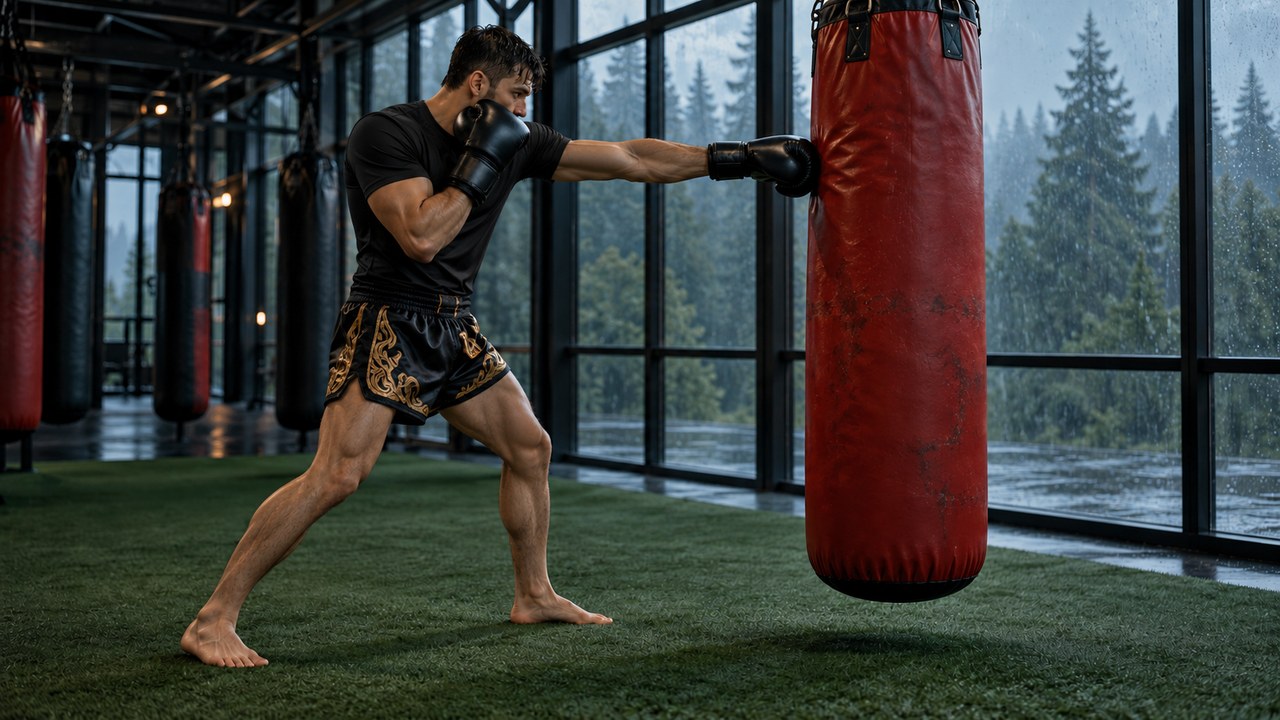
Five Key Takeaways for a Better Jab and Cross
Here’s a quick review of the five mistakes from Coach Longo’s video and what to do instead.
- Find Your Distance: If the target is out of range, close the gap with a short step using your Lead Foot instead of reaching forward.
- Maintain Your Balance: Keep your head and upper body from tipping too far forward. Finish each punch in a stable fighting stance.
- Extend Your Punches: Let your Jab and Cross reach the target with controlled extension. Don’t lock your elbow, and keep your other hand up.
- Rotate Your Fist and Elbow: Turn your fist gradually until your palm faces down and your elbow turns out. Keep your wrist aligned.
- Pivot Your Rear Foot: On the Cross, let your Rear Heel lift and your foot turn as your Rear Hip and Shoulder rotate. Stay balanced without over-rotating.
You don’t have to fix everything at once. Pick one detail, work on it until it feels natural, then move to the next.
When your Jab and Cross feel solid, add them to longer combinations:
5 Essential Kickboxing Combinations for Beginners
Improve Your Jab and Cross With Private Training in Portland
A good Jab and Cross is not about how hard you hit. It is about being ready for what comes next.
In my private Muay Thai and Boxing lessons, I work with beginners and returning students on their technique, one step at a time. We’ll focus on the details you need most and build from there at a pace that works for you.
If you’re in the Portland, Oregon area, reach out to me when you’re ready. Use the contact form on TrainWithSean.com.