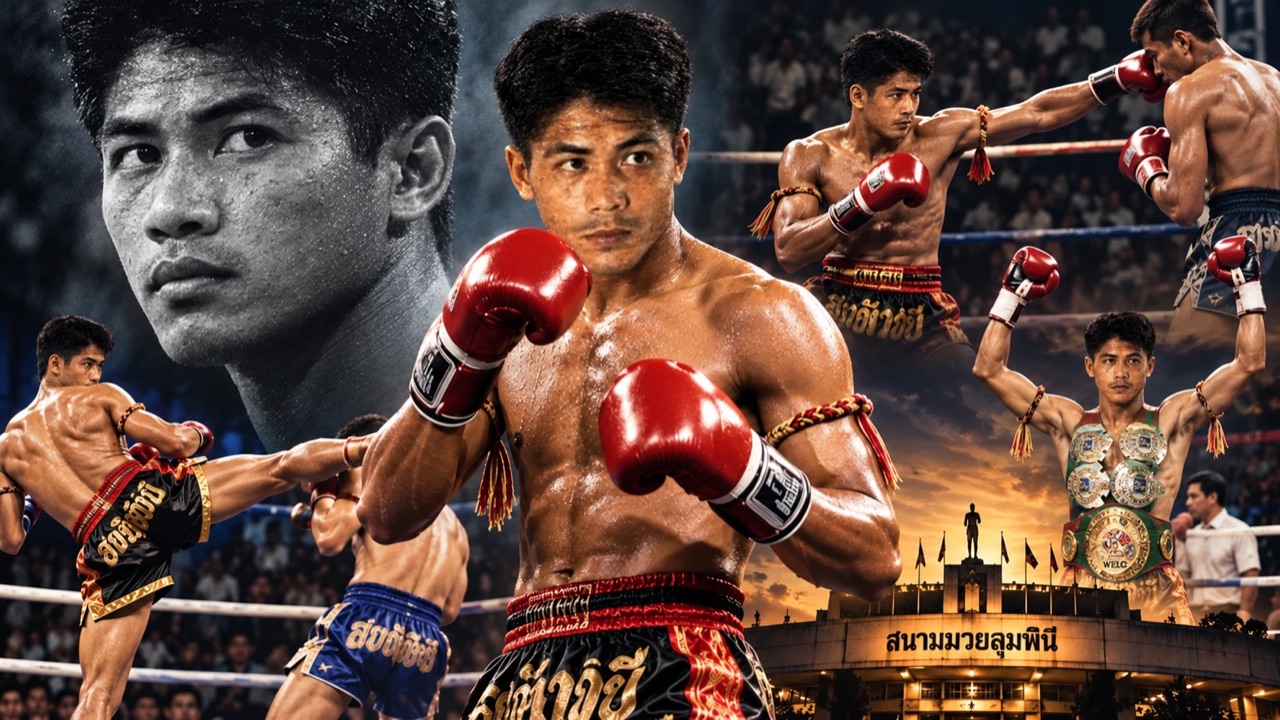
Samart Payakaroon (AI-generated art).
In Samart Payakaroon fights, he could stand in front of a hard puncher and make him miss by an inch. Then he would make him pay for it. Watching Samart Payakaroon fights is like watching a lesson in timing, balance and calm.
Samart Payakaroon is widely considered one of the greatest Muay Thai fighters of all time.
He won four Lumpinee Stadium titles in four weight classes before he turned 19. He was named Thailand’s Fighter of the Year three times.
Not sure where to start? A highlight video is right below. After that comes the story of his career, then all 13 entries on the list, by year, with each result.
Want to skip the history? Jump straight to the fights.
In this post:
Start Watching: Samart Payakaroon Highlights
Short on time? Start with this highlight video from Muay Thai Scholar. It runs about five minutes.
From Chachoengsao to Lumpinee Stadium
Samart was born Samart Thipthamai on December 5, 1962, in Chachoengsao Province, Thailand.
He started Muay Thai at about 10 years old, after his older brother brought him to the gym. That brother, Kongtoranee Payakaroon, became a Muay Thai champion as well.
Both brothers trained under Yodtong Senanan, known as Kru Tui. Kru Yodtong later became famous around the world as the founder of the Sityodtong camp.
Samart’s first fight name was Lotus. After about a dozen fights, he came to Bangkok in 1978 to fight at Lumpinee Stadium.
Four Lumpinee Titles Before He Turned 19
Samart won Lumpinee titles in four weight classes in about 20 months:
- February 11, 1980, Pinweight (102 pounds): beat Kongsamut Sor Thanikul by decision. He was 17 years old.
- November 11, 1980, Light Flyweight (108 pounds): beat Poollap Saknirun by decision.
- March 31, 1981, Super Flyweight (115 pounds): beat Singthong Prasopchai by decision. It was the first Lumpinee title ever awarded at that weight.
- October 13, 1981, Featherweight (126 pounds): beat Samingnoom Sithiboontham by decision.
The Sports Writers Association of Thailand named him Fighter of the Year in 1981. He won the award again in 1983 and 1988.
What Is Muay Femur?
Muay Thai fighters are often grouped by style.
A Muay Khao fighter wins with Knees.
A Muay Mat fighter wins with heavy punches.
Samart is one of the best examples of Muay Femur, the skillful style of Muay Thai. The name roughly means “skill boxing.”
A Muay Femur fighter cares more about clean technique than about how many strikes he throws. He wants to land the better shot and make the other fighter miss.
Samart could stand right in front of an opponent and look completely relaxed. When the opponent attacked, he moved just far enough for the strike to miss. Then he countered right away, or used the miss to step to a better angle.
He did not fight every opponent the same way. Against a fighter who pressed forward, he moved back and countered. Against a fighter who stayed outside, he stepped in with his kicks like his Teep or Round Kick.
Footwork: Less Is More
One of the most common mistakes I see beginners make is moving too much. They take several steps when one would do the job. Watch Samart’s footwork. He rarely moves without a purpose. He makes small adjustments to avoid strikes while staying in position to counter.
I always tell my students that good footwork isn’t about how much you move. It’s about being in the right place at the right time.
Samart vs. Dieselnoi: The Fight of 1982
On December 24, 1982, Samart fought Dieselnoi Chor Thanasukarn at Rajadamnern Stadium in Bangkok. It is one of the most famous fights in Muay Thai history.
The two men could not have been more different. Samart was a counter fighter.
Dieselnoi was a tall Muay Khao fighter, nicknamed “Lord Sky-Piercing Knee,” and the 1982 Fighter of the Year.
Dieselnoi walked forward all night, used his height in the clinch and scored with Knees. Samart tried to keep him from getting close.
After five rounds, Dieselnoi won a unanimous decision. The fight was named the 1982 Fight of the Year.
The Clinch (Plam / ปล้ำ): Every Style Has Its Challenges
No fighting style works perfectly against every opponent. Samart was one of the best technical fighters in Muay Thai history, but Dieselnoi’s height, forward pressure and clinch made the night extremely hard for him.
This is why I tell my students to train against different types of opponents. You might have great footwork and counters. But what happens when someone keeps coming forward, closes the distance and forces you into the clinch? Every Muay Thai student needs to learn how to handle that.
His Rivalry With Chamuekpet Hapalang
One of Samart’s toughest opponents was Chamuekpet Hapalang, a southpaw Muay Khao fighter nicknamed “Mr. Computer Knee.”
Chamuekpet liked to grab the clinch and land Knee after Knee. Samart wanted to stay at range and counter.
They fought three times at Lumpinee Stadium:
- Chamuekpet #1, August 8, 1980: Chamuekpet won by decision and took Samart’s Pinweight title.
- Chamuekpet #2, December 2, 1980: Samart won by decision.
- Chamuekpet #3, November 11, 1983: Samart won by unanimous decision.
Years later, Samart became one of Chamuekpet’s trainers. Two great rivals ended up on the same side.
A World Title in Boxing, Then a Return to Muay Thai
In 1982, Samart started fighting in Boxing too. In 1986, he knocked out Lupe Pintor in the fifth round to win the WBC Super Bantamweight World Championship.
He defended the title against Juan Meza, then lost it to Jeff Fenech in 1987.
Still, many fans remember Samart first as a Muay Thai fighter.
His Great 1988 Muay Thai Comeback
In 1988, Samart came back to Lumpinee Stadium and was named Fighter of the Year again. He faced some of the best fighters in Thailand:
- Panomtuanlek Hapalang: a strong Muay Khao fighter and the 1986 Fighter of the Year. Samart knocked him out in Round 1 on January 26, 1988, in the 1988 Fight of the Year.
- Samransak Muangsurin: a Muay Mat fighter known for heavy punches. Samart had beaten him in 1983, then beat him twice more by decision, on May 26 and June 24.
- Namphon Nongkeepahuyuth: a Muay Khao fighter and Lumpinee champion who fought Ramon Dekkers twice in 1990. Samart beat him twice in 1988, by doctor stoppage on October 28 and by unanimous decision on December 2.
On January 6, 1989, Samart knocked out Jaroenthong Kiatbanchong, a younger Lumpinee champion known as the “Fierce Tiger of the South,” with a Right Hook in Round 1.
On May 10, 1989, he lost a unanimous decision to Wangchannoi Sor Palangchai, a younger fighter famous for his straight punches. It was Samart’s last fight in the big Bangkok stadiums.
Throughout the 1990s, Samart continued competing internationally, taking on opponents in Japan, France, Germany, and Thailand. He added more victories to his impressive record, showcasing the timing, technique, and ring intelligence that made him one of Muay Thai’s all-time greats.
Watch Samart Payakaroon Fights
Most of these recordings are more than 30 years old, and some are fan copies, so the picture and sound vary.
The list has 13 entries. Each one is a single fight, except entry 4, which groups Samart’s three fights with Samransak Muangsurin because the videos do not say which night they show. Every result was checked against Samart’s published fight record.
Jump to a fight:
- 1984: Wattana Soudareth
- 1988: Panomtuanlek Hapalang · Samransak Muangsurin · Namphon Nongkeepahuyuth #1 · Namphon Nongkeepahuyuth #2
- 1993: Satoshi Niizuma · Murat Comert · Gilbert Ballantine · Paul Lenehan
- 1994: Maikel Lieuwfat
Samart Fights in 1982
1. Samart vs. Dieselnoi Chor Thanasukarn: Rajadamnern Stadium, Bangkok, December 24, 1982
Result: Loss by unanimous decision. Dieselnoi’s height and clinch against Samart’s range, over five rounds.
Want it explained as you watch? Sylvie von Duuglas-Ittu walks through the fight round by round in this commentary version. Thank you, Sylvie, for sharing this footage.
Samart Fights in 1984
2. Samart vs. Wattana Soudareth: Paris, France, September 21, 1984
Result: Win by TKO (Right Uppercut), Round 4. A Paris fight two years after Dieselnoi, ended by a single Right Uppercut.
Samart Fights in 1988
3. Samart vs. Panomtuanlek Hapalang: Lumpinee Stadium, Bangkok, January 26, 1988
Result: Win by KO (punches), Round 1. In a bout named the 1988 Fight of the Year, Samart stops Panomtuanlek’s attempts to close the distance and clinch, finishing him with punches in the opening round.
4. Samart vs. Samransak Muangsurin: Lumpinee Stadium, Bangkok
Result: Win by decision, all three times. They fought on April 5, 1983, May 26, 1988 and June 24, 1988. The videos below don’t say which fight they show. Samransak was one of the hardest punchers of his time, and Samart beat him on points each time.
This first video is a restored copy of the Boxing Works upload.
This second video is a different recording of Samart and Samransak.
5. Samart vs. Namphon Nongkeepahuyuth #1: Lumpinee Stadium, Bangkok, October 28, 1988
Result: Win by TKO (doctor stoppage), Round 3. The first of two fights with Namphon in 1988, and a doctor ends it.
6. Samart vs. Namphon Nongkeepahuyuth #2: Lumpinee Stadium, Bangkok, December 2, 1988
Result: Win by unanimous decision. The rematch goes the full five rounds, and the judges agree Samart won.
Samart Fights in 1989
7. Samart vs. Jaroenthong Kiatbanchong: Lumpinee Stadium, Bangkok, January 6, 1989
Result: Win by KO (Right Hook), Round 1. A Right Hook ends the night early against a younger champion.
8. Samart vs. Wangchannoi Sor Palangchai: Lumpinee Stadium, Bangkok, May 10, 1989
Result: Loss by unanimous decision. A younger fighter famous for straight punches wins, in Samart’s last fight in the big Bangkok stadiums.
Samart Fights in 1993
9. Samart vs. Satoshi Niizuma: MAJKF, Tokyo, Japan, April 24, 1993
Result: Win by unanimous decision. A 1993 return in Tokyo against a Japanese kickboxer.
10. Samart vs. Murat Comert: Paris, France, October 2, 1993
Result: Samart earned a second-round TKO victory when Comert was unable to continue the fight.
11. Samart vs. Gilbert Ballantine: King’s Birthday, Bangkok, December 4, 1993
Result: Win by unanimous decision. An experienced Dutch fighter on the King’s Birthday show in Bangkok.
12. Samart vs. Paul Lenehan: Palais des Sports, Paris, France, December 10, 1993
Result: Win by TKO (Knees), Round 3. Six days after the Ballantine fight, Samart finishes the Irish fighter with Knees.
Samart Fights in 1994
13. Samart vs. Maikel Lieuwfat: Germany, 1994
Result: Win by decision.
Great Fights With No Video Online
Many of Samart’s biggest wins came before most Muay Thai fights were filmed and saved. I could not find video of his title fights or his three Chamuekpet fights listed above. Three more are worth knowing:
- Mafuang Weerapol, June 9, 1981: Win by decision. The 1981 Fight of the Year.
- Padejsuk Pitsanurachan #1, March 12, 1982: Win by decision.
- Samart Prasarnmit, December 28, 1983: Win by unanimous decision at Rajadamnern Stadium. Two of the most skilled fighters of the era, and Samart took home the Yodmuaythai trophy.
What His Fights Teach a Muay Thai Student
Samart used the same techniques every Muay Thai student learns. What set him apart was when and how he used them.
1. The Teep: Timing Is More Important Than Power. When I teach the Teep, I remind students that they don’t always need to throw it harder to make it more effective. Timing can make all the difference.
Watch how Samart uses his Teep as an opponent moves toward him. He doesn’t just kick to push him away. He catches him as he steps forward, interrupting his attack and disrupting his opponent’s balance.
This is why I have students practice their Teeps against a moving partner. Learning when to throw a technique is just as important as learning how to throw it.
The Sideways Teep (Teep Khang / ถีบข้าง) is a variation of the traditional Muay Thai Push Kick. Instead of facing your opponent squarely, you rotate your hips and turn your body partially sideways as you extend your leg. You hit with your heel instead of the ball of your foot. This can give you additional reach and make your foot harder for an opponent to catch.
Samart Payakaroon was particularly skilled at using the Sideways Teep to control distance, stop aggressive opponents, and disrupt their balance. His excellent timing allowed him to keep opponents at his preferred range while creating opportunities for counterattacks.
See how to throw it in my Side Teep lesson.
Want to clean up your own Teep? Read Fix These 3 Teep Mistakes in Muay Thai.
2. Making punches miss, then countering. Samart made punches miss with very small moves. He knew how far a punch could reach and moved only as much as he needed to. Then he answered with a straight punch or a Hook.
Training lesson: defend your partner’s punch with a small slip, then return a counter punch before he gets his guard back.
See the punches and defenses Saenchai teaches in Defending the Cross (Mat Trong / หมัดตรง).
3. The Uppercut: Drive It Up From Below. Samart had a powerful Uppercut. In 1984, he ended his fight with Wattana Soudareth with a Right Uppercut in Round 4. Watch it.
A powerful Uppercut starts from the ground, using the legs, hips, and torso to generate explosive force. The punch travels upward in a short, compact motion, with the entire body working together to deliver power. Good balance, proper distance, and strong body mechanics are essential.
Timing is just as important as power. An Uppercut is especially effective at close range or when an opponent moves forward or lowers his head. When thrown correctly, it can slip underneath an opponent’s guard and land with great force, all without a big windup or wasted movement.
See how Saenchai throws his Uppercut in Muay Thai Punches and How to Defend Them: The Uppercut (Mat Ngat / หมัดงัด).
Want to Watch More Muay Thai and Kickboxing Legends in Action?
Watch 68 Buakaw Banchamek fights, from 2004 to 2026.
Watch 68 classic Peter Aerts fights, from 1988 to 2020.
Watch 47 classic Ernesto Hoost fights, from 1992 to 2014.
Learn the Fundamentals Samart Mastered
Samart faced powerful punchers, dangerous kickers, knee fighters, and some of Muay Thai’s most skilled technicians. What made him special was his ability to use balance, timing, footwork, and precision to overcome opponents with very different fighting styles.
After his fighting career, Samart went on to teach Muay Thai and Boxing in Thailand. Watch how he controls distance, maintains his balance, and picks his shots. There’s a lot to learn from his approach, whether you’re an experienced fighter or just getting started.
These are the same fundamentals I emphasize in my one-on-one Muay Thai private lessons in Portland, Oregon.
If you’re in the Portland area and interested in improving your Muay Thai skills, I’d love to work with you. Feel free to reach out through the contact form on TrainWithSean.com.