
Nong-O Gaiyanghadao, AKA Nong-O, doesn’t like to clinch, and most Nong-O techniques are built to stay out of it. His reason is simple: he’s short, and tall fighters are hard for him to tie up in the Thai Clinch (Plam /ปล้ำ).
So he built his whole style around timing and reading his opponent. He fakes, he switches, he sweeps, and he fights out of the clinch when someone grabs him.
Dan McGowan hosted this seminar at his gym, McGowan Muay Thai. He introduced Nong-O as a ONE Championship champion and “one of the best to do it.”
Then Nong-O showed a packed room the techniques that helped him throughout his Muay Thai career.
Below are the Nong-O techniques from that seminar, with a time stamp for each one. Click any time stamp, and the video will jump to that moment.
The Video: Nong-O’s Seminar at McGowan Muay Thai
Video: Dan McGowan Muay Thai YouTube channel.
In This Post:
Who Is Nong-O Gaiyanghadao?
Nong-O Gaiyanghadao is a Lumpinee Stadium champion from Thailand. Later in his career, he fights under the name Nong-O Hama.
In February 2019, he won the first ONE Bantamweight Muay Thai World Title. He beat Han Zi Hao at ONE: Clash of Legends in Bangkok.
Nong-O is known for his powerful kicks and high fight IQ. His teaching reflects that approach: use a fake to draw a reaction, read your opponent’s defense, and attack the opening.
You can see Nong-O’s powerful Round Kicks in action in this highlight video.
How to Read the Drills
I use two symbols to make the drills easier to follow, and here is what each one means.
- = (Equals Sign): What comes before the equals sign is the attack your opponent throws. What comes after it is how you defend or counter that attack.
- + (Plus Sign): Perform both movements at the same time, as one motion.
Every drill is written from the Orthodox Stance.
Words to Know
- Orthodox Stance: Your Left Foot and Left Hand are in front, and your Right side is in back. Most right-handed fighters stand this way.
- Southpaw Stance: The mirror of Orthodox. Your Right Foot and Right Hand are in front, and your Left side is in back.
- Inside: Your foot is between your opponent’s feet, or your arms are inside your opponent’s arms.
- Inward: Your leg or arm moves in toward your own Centerline.
- Sweep: You take your opponent’s leg out from under him with your foot or lower leg. He loses his balance or falls. Under Muay Thai rules, sweeps to the legs are allowed, but Judo-style throws over your hip or back are not.
- Centerline: The line that goes down your center and splits you between left and right.
- Crossface: A framing technique. You drive a stiff forearm, wrist or glove across your opponent’s face or jaw to turn his head away from the Centerline.
- Switch Kick: You switch your Lead Leg back slightly to get a little more power on your Lead Round Kick.
- Bicep Control: A Muay Thai Clinch technique where you use one or both hands to grip your opponent’s biceps (upper arms), just above the elbows. This lets you control his arm movement, stop him from locking a strong Thai Clinch, and create openings for Knees, Elbows and Sweeps.
- Lead Overhand Catch: You wrap your Lead Arm over the top of your opponent’s kicking leg and trap it against your body.
- Leg Shield: You lift your leg and block a kick with your shin.
- Rear Thrust Knee (Khao Trong /เข่าตรง): A Knee thrown with your Rear Leg that drives straight forward into your opponent’s stomach or ribs.
- Uppercut Elbow (Sok Ngat /ศอกงัด): An Elbow that comes straight up from underneath, like an Uppercut. The target is the tip of your opponent’s chin.
Drill 1: Fake the Teep, Then Jab
Watch it: 1:52
Combination: Fake Lead Teep to Jab
- Fake Lead Teep (Teep /ถีบ): Bring your Lead Knee above your belt line and turn your hip. Make it look like you’re about to kick him away.
- Jab (Mat Krathaek /หมัดกระแทก): He reacts to the fake. Throw the Jab while he’s busy defending a kick that never comes.
Tip: The fake only works after you’ve landed a few real Teeps. Get the reaction first, then fake it, and land the shot behind it.
Drill 2: Fake the Teep, Then Kick
Part A: Switch Kick
Watch it: 2:33
- Fake Lead Teep (Teep /ถีบ): Same fake as Drill 1. Bring the Lead Knee above your belt line.
- Switch Kick (Teh /เตะ): Switch your feet and throw the Lead Round Kick.
Part B: Rear Round Kick
Watch it: 2:57
- Fake Lead Teep (Teep /ถีบ): Same fake again, with a Lead Knee Feint.
- Rear Round Kick (Teh /เตะ): Nong-O switches his stance, making it look like he is going to throw a Switch Kick (Lead Round Kick). But he stops, stays in his Southpaw Stance, and throws a Switch Kick with his Right Leg.
Tip: Nong-O tries not to show the same technique twice in a row. When you use this move, mix it up and do both Part A and Part B. That way, your partner never knows which kick you will attack with.
Drill 3: Teep, Fake, Switch Kick, Sweep
Watch it: 4:00
Sweeps are a big part of Muay Thai. When you sweep your opponent and stay on your feet, the judges see that you control the fight and have better balance than your opponent.
A sweep also breaks your opponent’s rhythm. After he hits the mat once or twice, he gets careful about kicking and standing on one leg. That gives you more room to attack.
You don’t need power to land a sweep. You need timing, and that’s why this drill starts with a fake.
Combination: Lead Teep to Fake Lead Teep to Switch Kick to Broom Sweep + Lead Hand Push
- Lead Teep (Teep /ถีบ): A real one, to set the pattern.
- Fake Lead Teep (Teep /ถีบ): Same fake as Drill 1. Bring the Lead Knee above your belt line.
- Switch Kick (Teh /เตะ): Step across your opponent as you switch.
- Broom Sweep: I sometimes call this an Inside, Inward Leg Sweep. You sweep with your Lead Leg from inside his foot, and your leg moves in toward your Centerline.
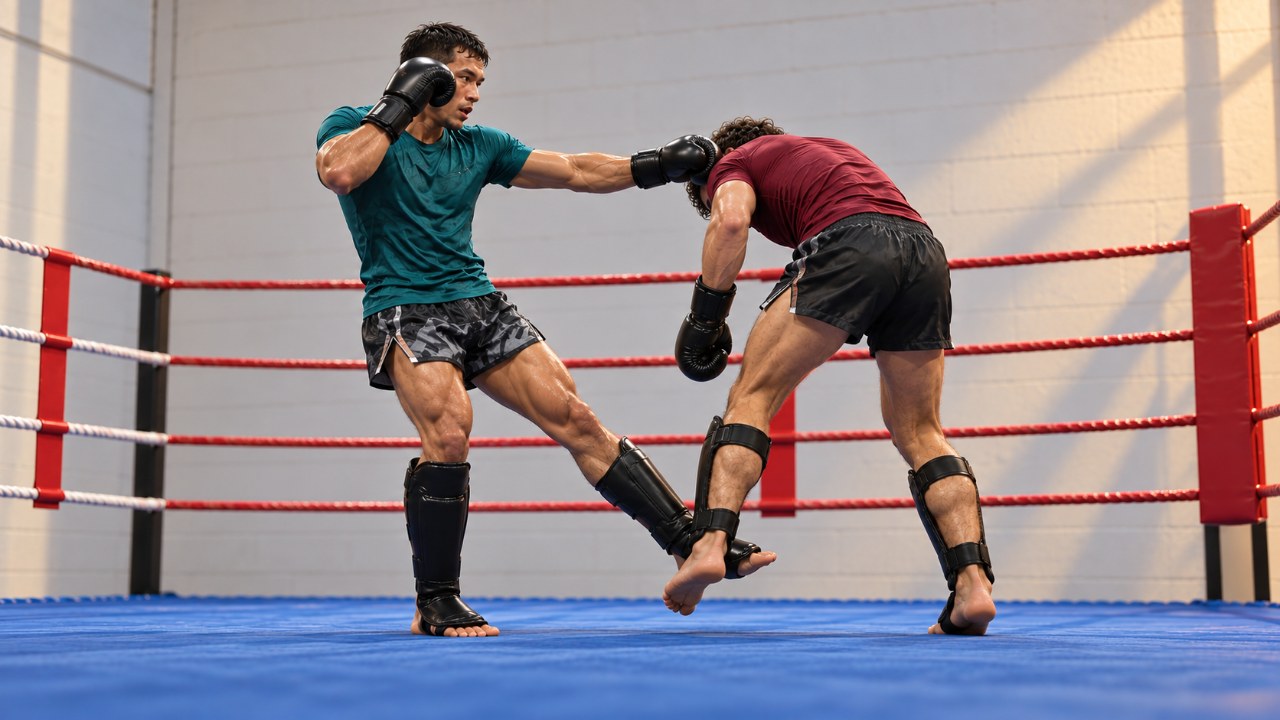
Notice how Nong-O also uses his Lead Arm to push his opponent as he sweeps. The push and the sweep together break his opponent’s balance.
Important Details of the Broom Sweep:
- Stay Square: Keep your chest and shoulders facing your opponent during the sweep. If you turn sideways, you’ll have trouble following up with another technique.
- Keep Your Foot Close: As your kicking foot comes down, don’t step too far back. The extra distance makes your sweep slower and harder to land.
- Stay Balanced: Don’t jump or throw your entire body into the sweep. If you miss, you’ll be out of position and leave yourself open to a counterattack.
- Move Immediately: The sweep should follow the Switch Kick without hesitation. You want to catch your opponent before he has time to regain his balance and reset his stance.
Drill 4: Fake the Kick, Then Punch to Round Kick
Watch it: 7:38
Part A: Feint the Left Round Kick, Punch Combo to Left Round Kick
- Switch Kick Feint: Do the Switch Step, but stay in a Southpaw Stance, from your Southpaw Stance, throw a Right Jab, Right Hook, Left Round Kick.
Part B: Feint the Right Round Kick, Punch Combo to Right Round Kick
- Rear Hip Feint: Swing your Rear Hip as if you’re about to throw a Rear Round Kick. Instead, throw a Jab, Lead Hook and Rear Round Kick.
Drill 5: Catch the Kick, Swing and Throw
Watch it: 8:20
Standard Response: Opponent’s Rear Round Kick = Lead Overhand Catch + Throw His Leg Away to Your Right + Rear Round Kick
Nong-O’s Preference: Opponent’s Rear Round Kick = Lead Overhand Catch + Swing His Leg to Your Right, Then Throw It to the Left + Rear Round Kick
Important Details:
- Use Your Wrist and Forearm: Hold the caught leg with your wrist and forearm, not your palm. Nong-O explains that a palm grip makes it easier for your opponent to escape and pull his leg out of your grip.
- Move His Foot Away from Your Centerline: Once you catch your opponent’s kick, don’t hold his foot directly in front of you. This gives him a chance to free his leg and Teep you backward or knock you off balance. Instead, swing his leg all the way to your right or left, keeping it away from your Centerline.
- Swing and Throw Before You Kick: First, swing your opponent’s caught leg to your right, then quickly throw it to your left. This sudden change in direction breaks his balance and makes it harder for him to defend your follow-up kick.
Drill 6: Turn Out of the Thai Clinch with a Crossface
Watch it: 10:20
This is Nong-O’s answer to an opponent with a strong Thai Clinch (Plam /ปล้ำ).
When your opponent has a tight clinch, you have very little room to work, and he’s in a good position to throw Knees.
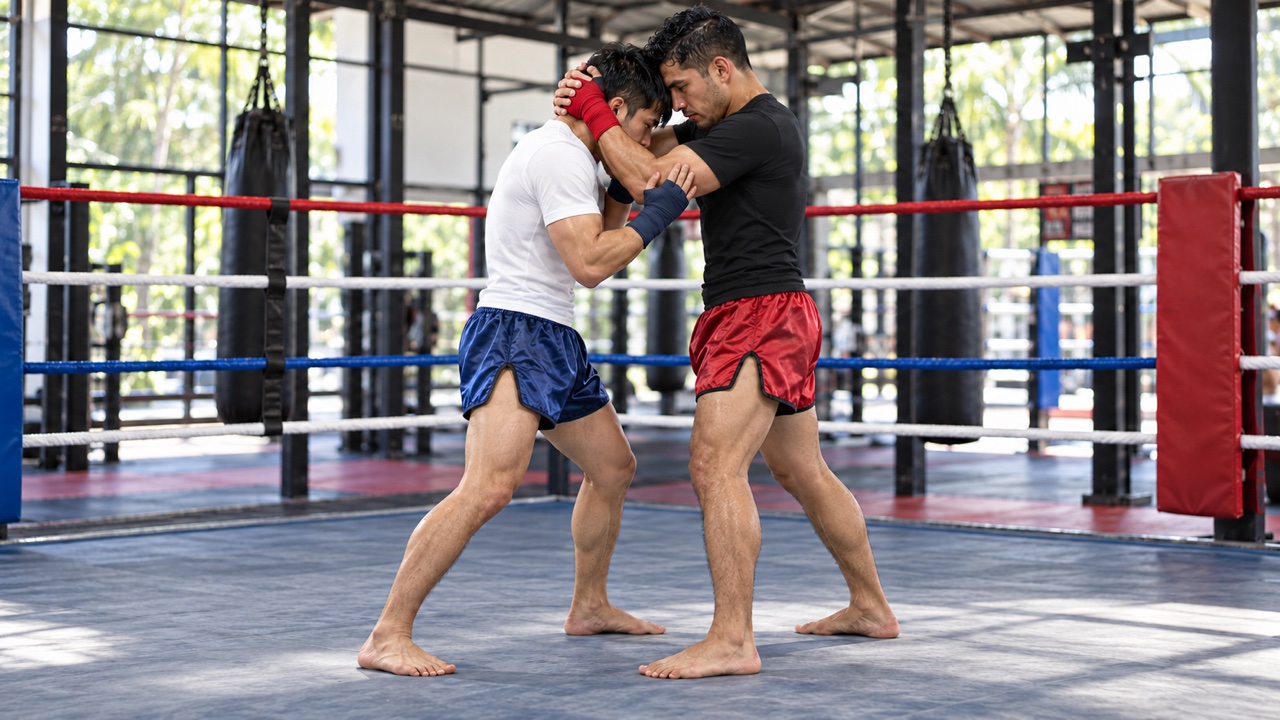
Nong-O’s solution is to turn first to create space, then use that opening to escape or counterattack.
Combination: Opponent Locks the Thai Clinch (a Neck Lock) = Circle to the Left + Left Hand Crossface + Snake Right Hand to Get Bicep Control
- Step 1, Turn Left: Your opponent locks the Thai Clinch with his head on your right side. Turn your body to the left, away from his head, to open a gap between you.
- Step 2, Left Crossface: As you turn, push upward on his chin with your Left Hand. This creates more space.
- Step 3, Snake for Bicep Control: Slide your Right Arm under your opponent’s arm, and snake your Right Hand to his biceps. This gives you inside control of his arms.
- Step 4, Counterattack: Once you have enough space, throw a Rear Thrust Knee (Khao Trong /เข่าตรง) or an Uppercut Elbow (Sok Ngat /ศอกงัด). You can also push him away and follow up with a kick.
What if his head is on your left side? Reverse the technique. Turn right, use your Right Hand to push his face away, and slide your Left Arm under to get Bicep Control.
Important Details:
- Turn Before You Try to Escape: Don’t fight straight against a strong clinch. Turning your body creates the space you need to work.
- Take Away His Knees: Once you turn, it’s harder for him to Knee you. His body no longer lines up with yours.
- Make Space Before You Counterattack: Don’t rush your Knee or Elbow. First, make sure you’ve broken his control and have your balance back.
Side Note: Nong-O calls this position a “Thai Style Lock.” In traditional Muay Thai, clinch fighting is an important part of scoring. In Stadium Muay Thai, Thai fighters often spend long stretches of a round working for control, throwing Knees and trying to off-balance their opponents.
Drill 7: Nong-O’s Signature Sweep
Watch it: 13:37
Of all the Nong-O techniques in this seminar, this is his signature, and he lands it often.
- Step 1, Draw the Leg Up: The goal is to draw your opponent’s leg up with a body feint or a real Rear Round Kick. Your opponent lifts his leg to block with a Leg Shield.
- Step 2, Hop In: As your opponent lifts his Lead Leg, hop forward with a Lead Knee Feint to close the range + your Lead Arm underhooks his Lead Leg + your Rear Arm Stiff Arms his upper body.
- Step 3, Kick Out the Support Leg: Your Rear Round Kick kicks out behind your opponent’s supporting leg.
To see how a Leg Shield works, read Muay Thai Kicks and How to Defend Them.
Important Tip: Nong-O stresses stepping toward your opponent’s foot when you go for the sweep. You need to close the distance to make it work. If you stay too far away, you’ll have a hard time catching his leg and finishing the sweep.
Light Sparring to Finish the Seminar
Watch it: 16:03
Nong-O finishes the seminar with light sparring sessions with the people who came to it.
For more Seminar Sunday breakdowns, check out:
There’s also a great sparring course on Evolve University. It features Nong-O and other Muay Thai World Champions.
Watch the Muay Thai Training Series: Sparring Drills course on Evolve University.
Want to learn from Nong-O himself? His instructional course covers his kicks, sweeps, stance switching and clinch work.
Watch Nong-O’s Power and Precision course on Evolve University.
Train These Nong-O Techniques in Portland
Nong-O shows how a simple fake can set up a powerful attack. By drawing out his opponent’s reaction, he creates openings for kicks, sweeps and clinch techniques.
Learning these techniques takes more than watching a video. You need to develop the timing, balance and ability to read your opponent’s reactions.
In my private lessons, we break each technique down step by step. We start with the fake, learn how to read the reaction, and then add the attack.
If you’re in the Portland, Oregon area and want to improve your Muay Thai, learn more about my Muay Thai private lessons or reach out through my contact form when you’re ready.