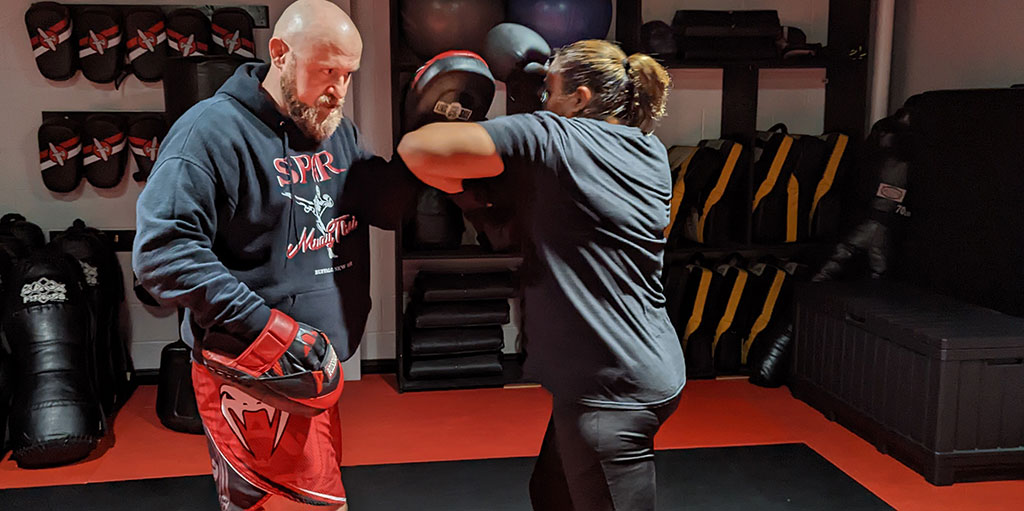
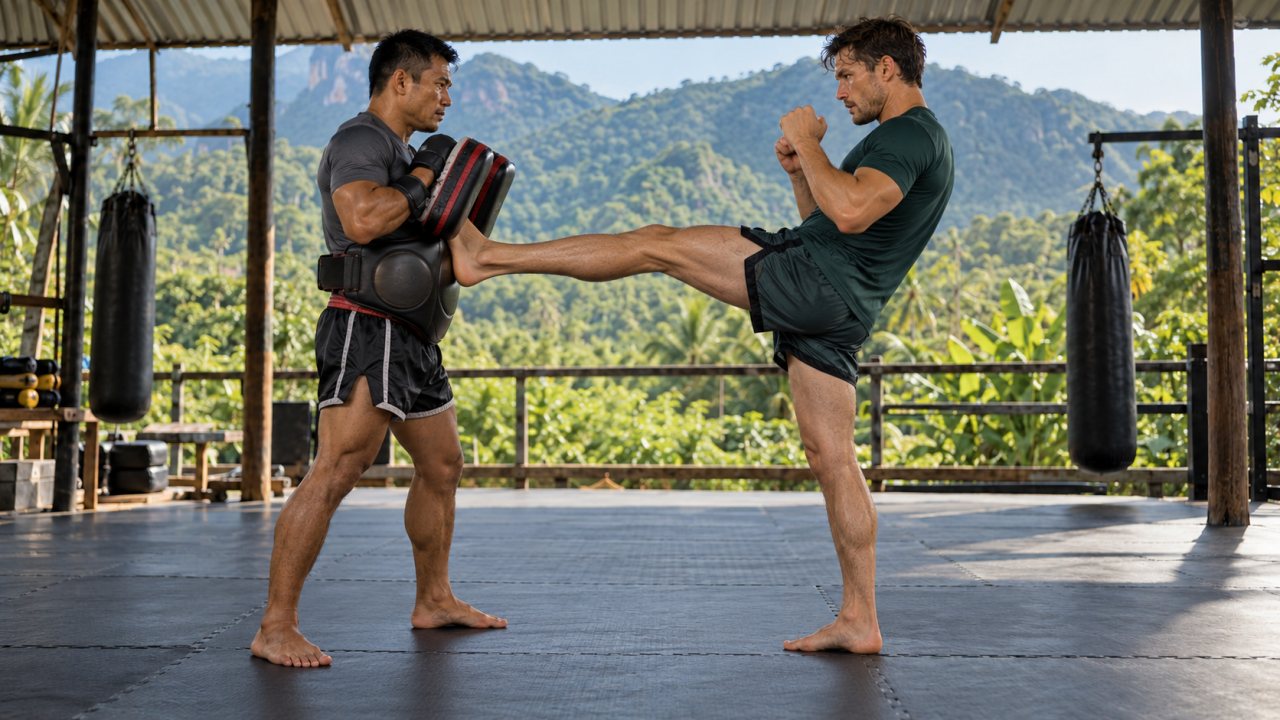
Ask three Muay Thai instructors how to throw a Teep, and you might get three different answers.
One instructor tells you to swing your arm downward. Another tells you to extend your arm toward your opponent. A third might tell you to keep both hands up.
So who’s right? That’s one of the things I enjoy about studying martial arts. Different instructors often have different approaches to the same technique.
In this article, we’ll look at the Muay Thai front kick, also called the Teep or Foot Jab, compare it with the Karate Front Kick, and see why different instructors teach different methods.
In this post:
The Muay Thai Front Kick (Teep), the Foot Jab, and the Karate Front Kick
If you’ve trained in Karate, you’re probably familiar with the Front Kick. In Muay Thai, the Front Kick is called the Teep (ถีบ). Here in the United States, you’ll also hear some coaches call it the Foot Jab.
Foot Jab is just another name for the Teep. Front Kick is a broader category, and it includes the Karate variations we compare below.
I like the name Foot Jab because it tells you something about how the kick works.
Think about the Jab in Boxing. You can use it to control distance, interrupt an attack, or keep someone from getting too close. The Teep, or Foot Jab, can do many of those same things, except you’re using your leg instead of your arm.
Both martial arts use a Front Kick. The differences are in how you throw it and what you use it for.
Karate has two main versions of the Front Kick, or Mae Geri.
Video: Andre Bertel YouTube channel.
Mae-Geri Keage (前蹴り蹴上げ), the Front Snap Kick: Your knee comes up, then your lower leg snaps out at the target and pulls right back. The goal is a fast, sharp strike.
Video: Shihan Yokota, Asai Ryu Karate YouTube channel.
Mae-Geri Kekomi (前蹴り蹴込み), the Front Thrust Kick: Instead of snapping the kick, you drive your leg and hip forward into the target. It’s a deeper, pushing kick, and it’s the Karate kick closest to the Muay Thai Teep.
Anderson Silva used the Mae-Geri Keage (前蹴り蹴上げ) to knock out Vitor Belfort. He snapped the kick straight up into Belfort’s chin. It’s one of the best examples of the Front Snap Kick landing in an MMA fight.
Video: Mo Dmy YouTube channel.
The Muay Thai Teep (ถีบ) is a thrusting kick. You lift your leg, drive your hip forward, and strike with the ball of your foot. Some versions use the heel.
The Teep, or Foot Jab, is especially useful for controlling distance, stopping an opponent from stepping in, interrupting his attacks, and knocking him off balance.
Karate and Muay Thai both have more than one version of the Front Kick. The biggest differences come down to how you throw it and when you choose to use it.
Want a coach to help work on your Teep? See my Muay Thai private lessons in Portland.
Using the Foot Jab as a Defensive Weapon
In this video from theacademy YouTube channel, the instructor focuses on using the Foot Jab as a defensive weapon. He also teaches a few details about balance and hand position that are worth taking a closer look at.
Video: theacademy YouTube channel.
One of the main points in this video is that the Foot Jab works best when your opponent is coming toward you.
For example, let’s say your opponent starts charging forward with punches. A well-timed Teep to the body can stop him in his tracks or knock him backward.
You can also use it to interrupt a kick.
If your opponent starts throwing a Round Kick, you can Teep him in the thigh or hip before he gets the kick off. You’re basically stopping his attack before it has a chance to develop.
These are two good examples of why the Teep is such an effective defensive tool.
The instructor also makes an important point about what happens when you chase someone with your Foot Jab.
If you’re constantly stepping forward trying to land the kick, you can end up putting too much weight on your Lead Leg when you come down. That makes it easier for your opponent to counter with a Leg Kick.
Instead, work on your timing. Let your opponent close the distance and use your Foot Jab to interrupt his movement.
Your Standing Leg Is the Foundation
One thing I keep coming back to when teaching the Teep is balance.
It doesn’t matter how hard you can kick if you can’t stay on your feet.
In this video, the instructor emphasizes keeping your supporting foot flat on the floor. If you’re up on your toes, it’s much easier for someone to knock you backward.
Here’s how he breaks down the Foot Jab:
- Start with a solid stance. Keep your weight balanced and turn your supporting foot slightly outward.
- Bring your knee up. Lift the kicking leg in front of your body.
- Drive your hip forward. Extend your leg toward the target, using your hip to put some force behind the kick.
- Pull your leg back. Retract the kicking foot before you put it down.
- Return to your stance. Get your feet underneath you so you’re ready to defend or attack again.
The important thing is to maintain your balance throughout the movement.
What Should You Do With Your Arms?
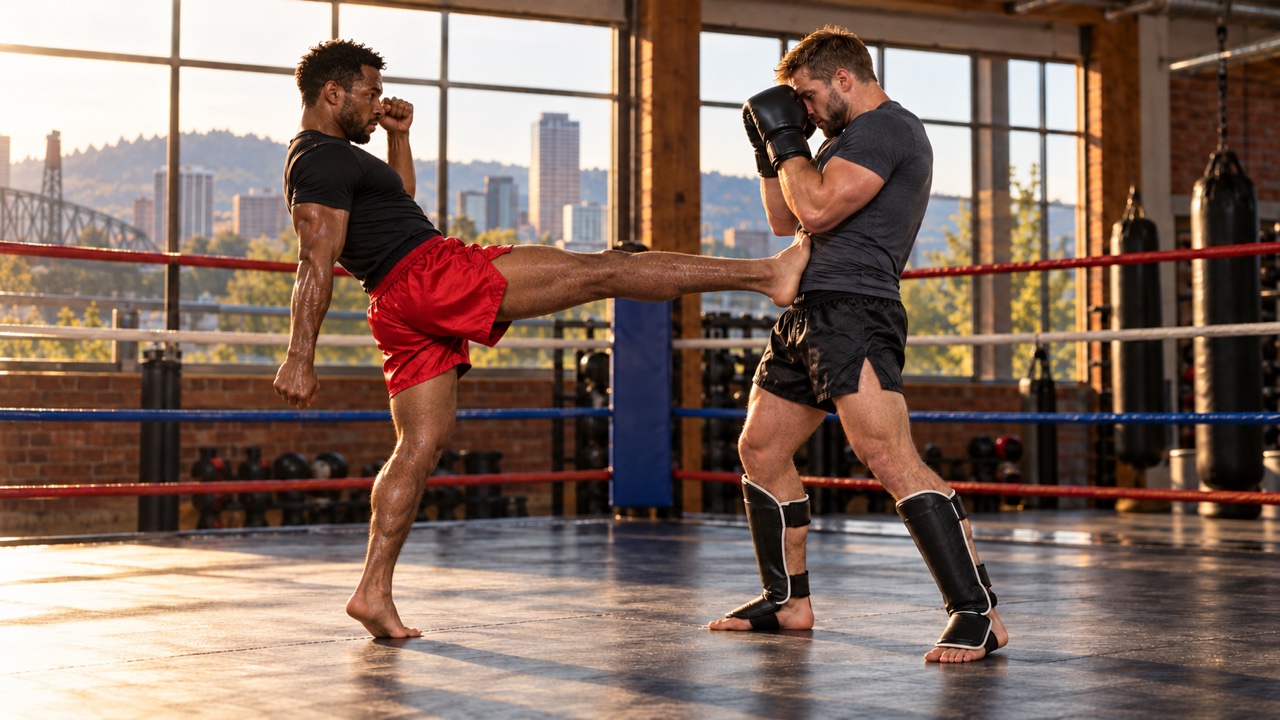
If you’ve been following this Teep (ถีบ) series, you’ve probably noticed that different Muay Thai coaches teach different arm positions when throwing the Teep.
Some coaches teach you to swing your arm on the kicking side in a downward fashion. Others prefer keeping the hands closer to your face.
The instructor in the Foot Jab video does something different.
Instead of swinging his arm down, he extends it straight toward his opponent.
If he throws a Lead-Leg Teep, he extends his Lead Arm. If he throws a Rear-Leg Teep, he extends his Rear Arm.
Why?
His reasoning is primarily defensive.
First, the extended arm gives you another line of defense.
Let’s say you throw a Teep and your opponent throws a punch at the same time. The logic is that you will be able to block his punch.
Second, the arm can help you maintain your balance.
By extending one arm forward and keeping the other hand near your face, you’re creating a defensive frame while throwing the kick.
In Part 3 of this series, we watched Damien Trainor demonstrate a different approach. He swings the arm on the kicking side downward to help generate power.
Fix These 3 Teep Mistakes in Muay Thai
In the theacademy video, the instructor extends that same arm forward for defensive purposes.
Two coaches. Two different methods.
Which Method Works Best?
You’ll see this throughout Muay Thai and any martial art, really. Sometimes those differences come from how the Coach was taught. Other times, they’re based on how the Coach personally likes to fight.
I wouldn’t automatically say one method is right and the other is wrong.
A downward arm swing can help generate power. Extending the arm forward can help you manage distance and provide an additional defensive barrier. Keeping your hands high has its own advantages.
The goal is to understand the differences and discover what works best for you.
Put It to the Test: Heavy Bag Drill
Toward the end of the main video, the instructor demonstrates a simple Foot Jab/Teep (ถีบ) drill.
You don’t need anything fancy for this one. Just a heavy bag and enough room to move.
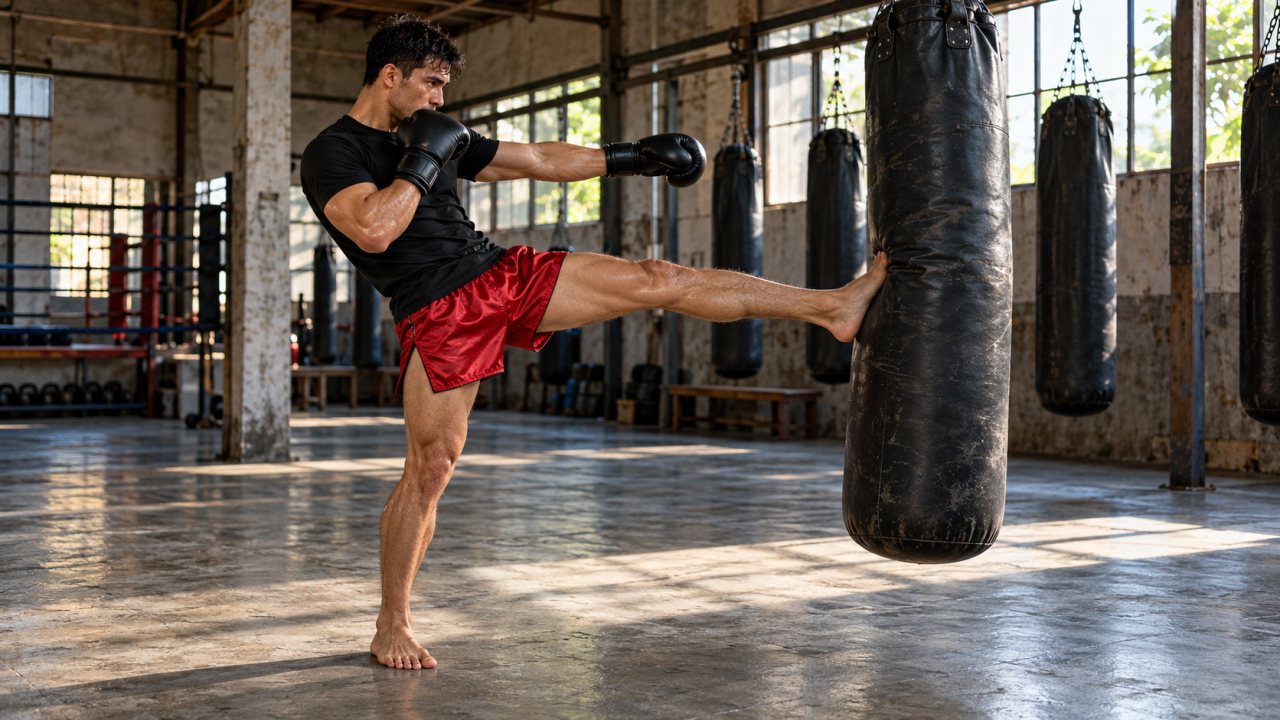
Start with your Lead Leg.
Throw three Foot Jabs in a row, bringing your foot back to your stance after each kick.
Then do the same thing with your Rear Leg.
Once you’re comfortable, start alternating between your Lead and Rear Legs.
Here are a few things I’d pay attention to:
- Balance: Keep your supporting foot planted and avoid falling backward.
- Hip movement: Drive your hip into the kick instead of simply lifting your leg and pushing.
- Recovery: Bring your kicking leg back under control before setting it down.
- Hand position: Practice extending the arm on the kicking side, as demonstrated in the main video.
- Stance: Make sure you’re ready to move, defend, or throw another technique after every kick.
Don’t worry about kicking as hard as possible.
Start slowly and concentrate on your technique. Have Good Form first, Speed and Power come later.
You can also practice both arm positions we’ve discussed in this series and get a feel for the differences.
If you’re new to the Teep, my article 5 Ways to Use the Muay Thai Push Kick is a good place to start. It covers several ways to use this versatile kick.
For another perspective, check out Tawanchai’s Powerful Teep: 5 Lessons From a Muay Thai World Champion, where we look at how one of Muay Thai’s top fighters approaches the technique.
Final Thoughts: Experiment and Find What Works
After more than 40 years of training and teaching martial arts, one thing I’ve learned is that there’s rarely just one way to approach a technique.
My advice is simple: Learn the fundamentals, understand why different instructors teach different methods, and experiment with them in your own training.
Keep what works. Continue practicing what doesn’t. And remember that what works in one situation might not work in another.
Train Muay Thai in Portland, Oregon
The Teep is one of those techniques that looks simple until you start working on it. Lifting your leg is easy. Delivering a strong kick while maintaining your balance, protecting yourself, and recovering into your stance takes practice.
In my private Muay Thai lessons, we work on the details that make these techniques effective, including foot position, balance, timing, and distance.
Learn more about my Muay Thai private lessons in Portland.
If you’re in the Portland, Oregon area, reach out to me when you’re ready. Use the contact form on TrainWithSean.com.