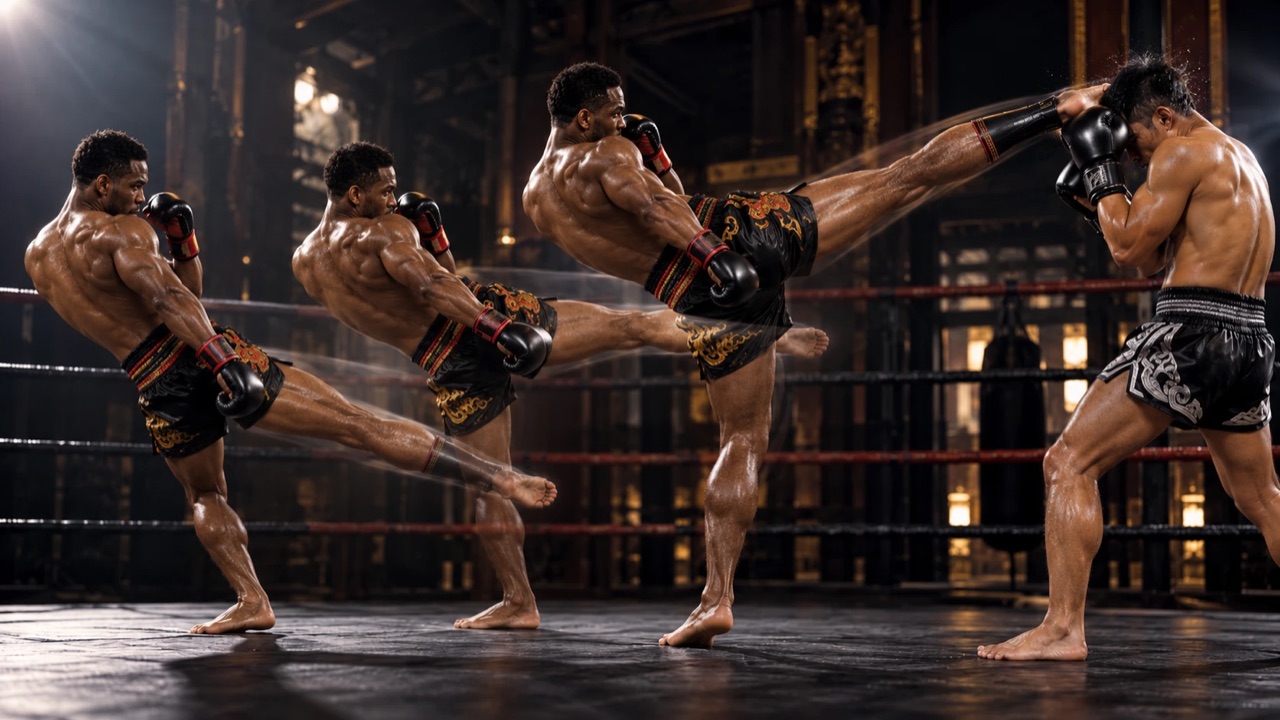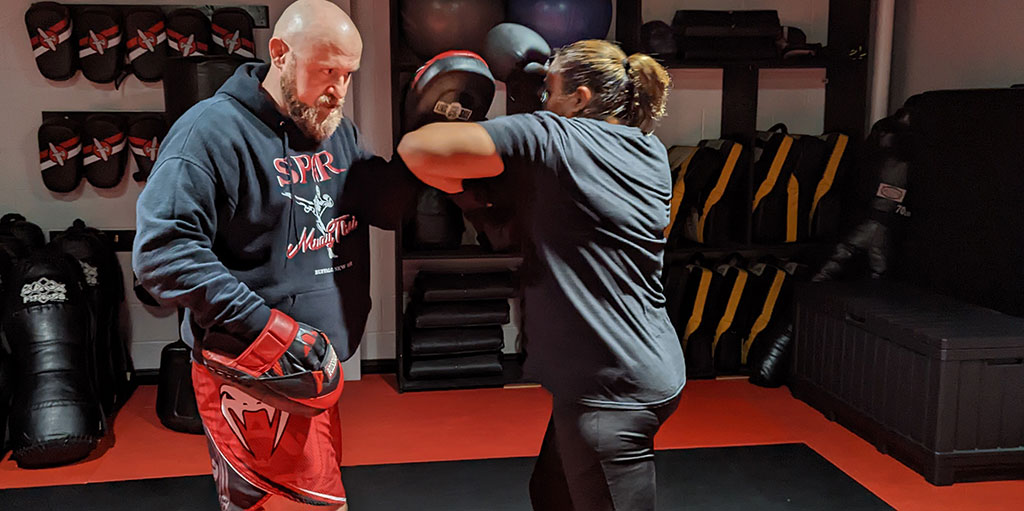
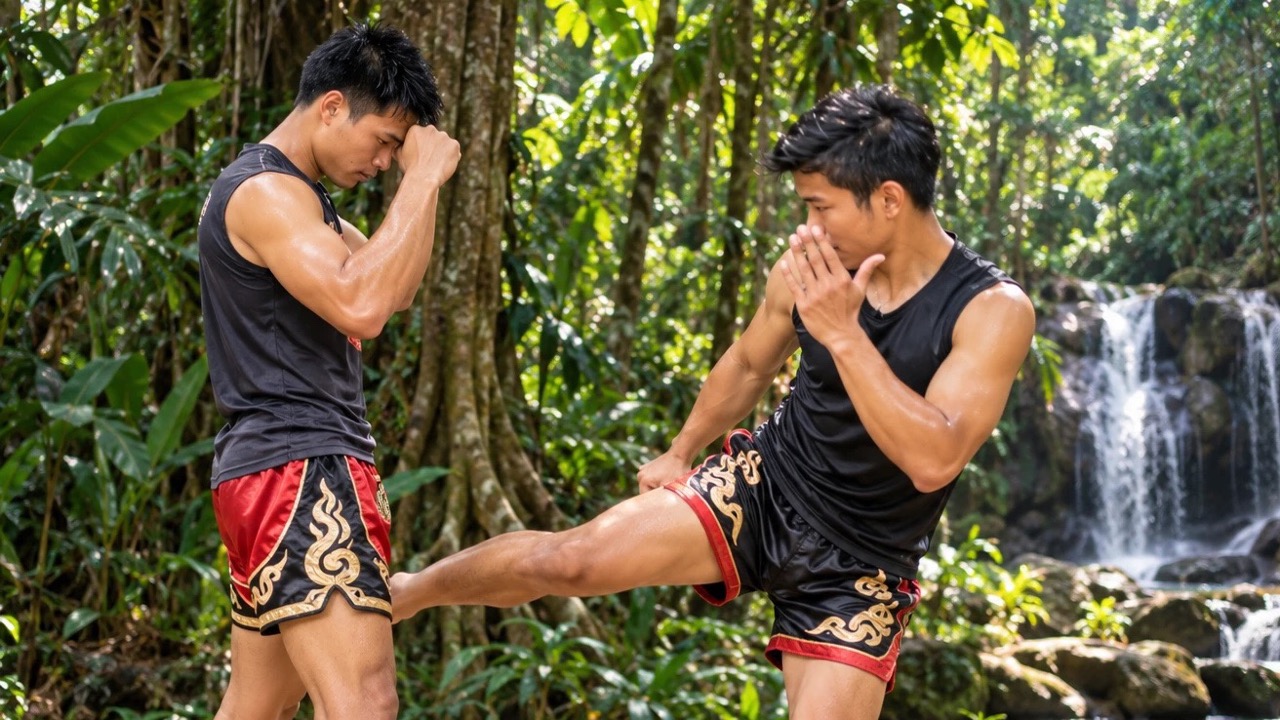
Want to learn how to kick in Muay Thai or improve your Round Kick? One of the best ways is to watch how experienced Thai trainers teach it.
In Thailand, the word for kick is Teh (เตะ). The instruction is often straightforward. Trainers demonstrate the technique, show you the correct body position, and have you practice each movement until it feels natural.
This lesson comes from Yod Muay Thai Gym, which has four locations in the Bangkok area. The video breaks down the Round Kick step by step, helping you understand how to use your feet, hips, and body position to develop better balance, technique, and power.
The video is in Thai, so I’ve explained each step in plain English. Click any timestamp below to jump directly to that part of the lesson.
Watch the Original Lesson in Thai
Video: Yod Muay Thai Gym on YouTube.
Two trainers lead the lesson: Khun Diew and Khun Nook. “Khun” is a respectful Thai title, similar to “Mr.” in English. One demonstrates the kicks while the other helps show the correct leg position and holds the kicking pad.
You can turn on English captions on YouTube, but the translation isn’t always accurate. Pay close attention to how the trainers move, especially their footwork, hip rotation, and body position. Watching their technique will teach you more than relying on the captions alone.
Words to Know
These Thai words help you follow what a Thai trainer is saying:
- Left (Sai /ซ้าย): The left side. In an Orthodox Stance, your left side is your Lead side.
- Right (Khwa /ขวา): The right side. In an Orthodox Stance, your right side is your Rear side, the side you kick with in this lesson.
- Leg (Kha /ขา): The lowest target. A kick to the leg lands on the thigh.
- Body or Ribs (Lam Tua /ลำตัว): The middle target, the side of the body over the ribs.
- Head (Hua /หัว): The highest target.
- Sawasdee krap (สวัสดีครับ): The Thai way to say hello and goodbye. The trainers say it at the end of the lesson.
Step 1: Get Into Your Stance
Every kick starts from your stance. The trainers set it up first:
- Right-handed (Orthodox Stance): Left foot in front, right foot behind.
- Left-handed (Southpaw Stance): Right foot in front, left foot behind.
The lesson teaches the kick with the back leg. For a right-handed fighter, that is the Rear Round Kick, thrown with the right leg.
For more on the base every kick comes from, read my post on how Saenchai teaches the Muay Thai stance.
Step 2: Understand the Proper Kicking Position
In this part of the lesson, the trainers slow down the Rear Round Kick so you can see exactly how your body should be positioned. One trainer throws a kick to the body while his partner catches the leg and holds it in place.
This gives you a clear look at three important parts of the technique:
- Strike with your shin: Your shin should make contact with your opponent’s body, not your foot. At the point of impact, your shin should be roughly parallel to the floor.
- Pivot on your supporting foot: Turn the foot you’re standing on so your heel rotates toward your target. This allows your hips to rotate freely through the kick.
- Rotate your hips: Roll your kicking hip through the kick, so your whole body is behind it.
This is a good way to practice with a partner. Kick slowly, let your partner hold your leg, and check your kicking position before you put it down.
Tip: Khun Diew explains that how you pivot depends on the target. When you kick your opponent’s leg, you still pivot, but you can keep your foot flat on the ground. When you kick the body or the head, rise up onto the ball of your foot. That lift gives you more power on the higher targets.
For a great example of a kick to the head, see how Andre Fili set up his Head Kick knockout.
Step 3: Swing the Arm
Next, Khun Diew adds the swing of the arms. As the Rear Leg kicks, the Rear Arm swings down and back.
The arm swing turns your shoulders with your hips. It also keeps you balanced, so you don’t fall over after a big kick.
Step 4: Keep Your Other Hand Up
While one arm swings, the other hand stays up by your face. Khun Diew shows this with a partner, because a kick opens you up to a counter punch.
Tip: Swing one arm, guard with the other. If both hands drop, your face is open the moment you kick.
Step 5: Kick the Pad
Once your kicking position is right, get a partner to pick up a kick shield. Now you as the kicker can put the steps together and kick for real.
Start by throwing your kicks slowly, focusing on proper technique rather than speed or power. Just like in Step 2, check that you’re striking with your shin, pivoting on your supporting foot, rotating your hips, swinging one arm, and keeping your opposite hand up to protect your face.
Once you can perform the kick correctly and consistently, gradually increase your speed and power.
Tip: After each kick, bring your leg straight back to your stance, with your hands up. That way you’re ready to kick again or block a counter.
How to Kick in Muay Thai: Putting It All Together
The biggest lesson from Khun Diew and Khun Nook: learn the Rear Round Kick one step at a time. Instead of rushing into hard kicks, they get the technique right first.
You can follow the same approach in your own training, starting with slow kicks and no pad. Focus on your balance, your foot pivot, and your hip rotation.
Once those movements feel natural, add the arm swing and keep your opposite hand up to protect your face.
When the whole kick feels smooth, move on to the pad. Start slowly, then add speed and power a little at a time, without letting your form slip.
A good Rear Round Kick does more than hit hard. It lands with power while you stay balanced, keep your guard up, and stay ready for your opponent’s next move.
Train Your Kick in Portland
Learning how to kick in Muay Thai starts slow: your stance, the proper kicking position, the arms, the guard, then the pad. Thai trainers hold the kick still so you can see it, and that habit works anywhere.
A video can show you the proper kicking position, but it can’t watch yours. In my Muay Thai private lessons in Portland, Oregon, I hold the pads and check each part of your kick. If you are new to the art of Muay Thai, read what to expect at your first Muay Thai class.
If you’re in the Portland, Oregon area, reach out to me when you’re ready. Use the contact form on TrainWithSean.com.